rauschpt, Author at Rausch Physical Therapy & Wellness - Page 22 of 30

Blog

2016 San Diego Triathlon Challenge: Help Us Support CAF


You can provide people with physical challenges with the tools necessary to find success in sports — and life!

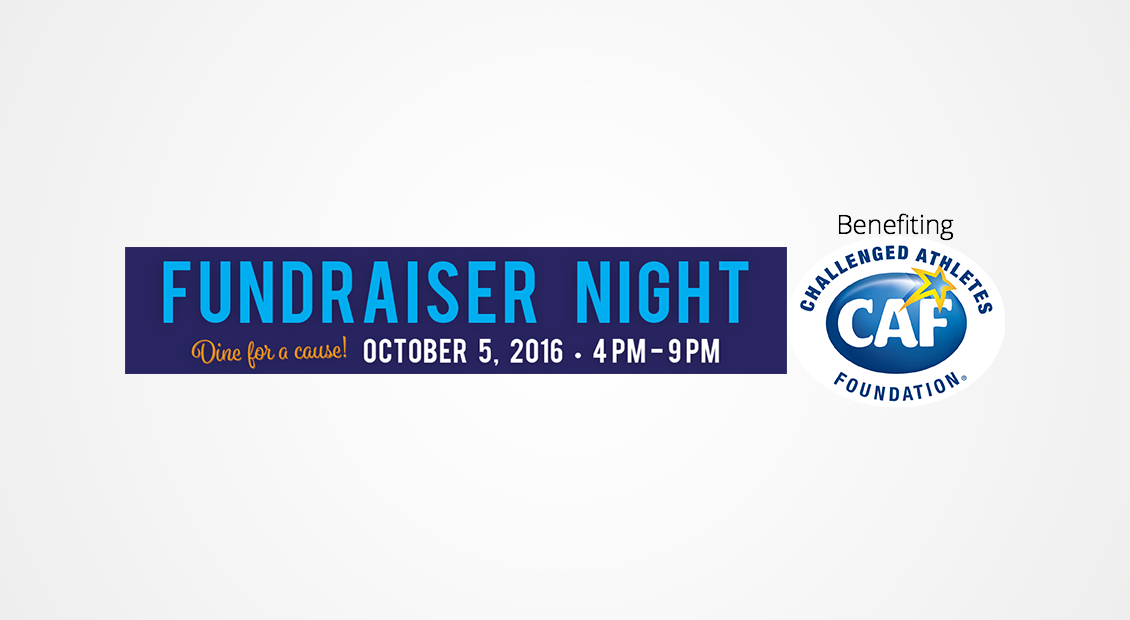
Dine for a Cause! Fundraiser Night

[one_third]

BENEFITING

[/one_third][one_third]

HOSTED BY

[/one_third][one_third_last]

LOCATION:

Avila’s El Ranchito – Laguna Niguel
27941 La Paz Rd. Suite E
Laguna Niguel, CA[/one_third_last]

Dine at Avila’s El Ranchito in Laguna Niguel between 4 – 9 PM on October 5, and 20% of the proceeds will go towards our team fundraising goal for the CAF San Diego Triathlon Challenge.

[button link=”https://secure2.convio.net/caf1/site/Donation2;jsessionid=7E91D043124696592F98876ECDB8EF1A.app258b?df_id=1721&PROXY_ID=3705&PROXY_TYPE=22&FR_ID=1190″ size=”small” color=”blue” align=”center” target=”_blank” ]DONATE NOW[/button]    [button link=”https://rauschpt.net/wp-content/uploads/2016/09/CAF2016-flyer.pdf” size=”small” color=”blue” align=”center” target=”_blank” ]VIEW FLYER[/button]   [button link=”https://www.facebook.com/events/303499553354396/” size=”small” color=”blue” align=”center” target=”_blank” ]RSVP ON FACEBOOK[/button]


Meet Team Rausch PT/STRIVE

[one_third]

On October 23, Team Rausch PT/STRIVE will be competing in the San Diego Triathlon Challenge, which helps raise funds for challenged athletes around the world. Our team is made up of thee local CAF athletes, Rausch PT staff and STRIVE Omni Sport members.
By making a donation, you can help us reach our fundraising goal and help provide adaptive equipment and opportunities for challenged athletes to find success in the sports they love.

[button link=”https://secure2.convio.net/caf1/site/Donation2;jsessionid=7E91D043124696592F98876ECDB8EF1A.app258b?df_id=1721&PROXY_ID=3705&PROXY_TYPE=22&FR_ID=1190″ size=”small” color=”blue” align=”center” target=”_blank” ]DONATE NOW[/button][/one_third]

[one_third]

AMY HANSEN
Challenged Athlete – 5K

Amy was born with XP/TTD Complex, a rare disease that affects all of her body systems. Participating in sports was out of reach for Amy until she started working with Dustin Hancock of Rausch PT. Together, they have worked to get Amy strong enough to run, and they are excited to meet the CAF 5K Challenge together.

Read more about Amy’s inspiring story in her Rausch PT Client Spotlight »[/one_third][one_third_last]

DUSTIN HANCOCK
5K

While Dustin is “The Cycling PT,” he also specializes in neurological issues and holds CAF’s mission near to his heart.

“As a physical therapist, I get to help people realize what they can do, not what they can’t do. SDTC allows everyone to see these great individuals thrive and make the impossible happen.” [/one_third_last]

[one_third]


JOHN ELLIOTT
Challenged Athlete – Bike

An industrial lab accident left John with health issues that halted his life-long love of cycling. That is, until he got an adaptive trike and met two fellow Challenged Athletes who encouraged him to re-enter competitive events through CAF—at the age of 65! John is now back to racing and is a CAF Mentor.

“Working with athletes facing many different physical challenges reaffirms my belief that, “The easy roads only lead downhill. You owe yourself the climb!”[/one_third][one_third]

KEVIN CAPATA
Run

As “The Triathlon PT,” Kevin couldn’t pass up the chance to join the team.

“It’s more of an honor and privilege, being able to participate in the same event as the CAF athletes. Can’t wait to be a part of such a great cause!”[/one_third][one_third_last]

ASHLEY HELLER
Swim

As “The Water Sports PT” and an avid surfer, Ashley was a natural choice for the open water swim!

“I first stumbled upon the CAF triathlon when I lived in La Jolla Cove while attending UCSD, and I was amazed and completely humbled to see the athletes charging! I am so excited to participate in the swim leg for such a great cause.”[/one_third_last][one_third]

GARY BUTCHER
Challenged Athlete – Run

Gary was injured in an accident as a professional motocross racer 26 years ago. Since then, Gary has continued racing as a T3 paraplegic, participating in marathons, handcycle events and triathlons.

“I have participated in the San Diego Triathlon Challenge before and enjoy being active and supporting the CAF, to help others like myself get involved in sport and get assistance in obtaining the equipment to be able to participate.”[/one_third][one_third]

JASON KING
Bike

Jason joins our team as a member of STRIVE Omni Sport.

“I did SDTC a few years back, and it was so inspiring to see everyone out doing what they love and being able to overcome whatever obstacle that may have been thrown at that them with determination.”[/one_third][one_third_last]

BRYAN STONE
Swim

Bryan joins our team as a member of STRIVE Omni Sport.

“Every time I see a challenged athlete at a race, it puts my own pain and discomfort in perspective as I quickly realize how much I have to be grateful for. I am honored to join my teammates to push hard and do our best on race-day.”[/one_third_last]

[one_third]

SEAN SWOPES
Run

While he’s more comfortable on two wheels as “The Mountain Bike PT,” Sean is taking on the Run at SDTC.

“Being physically active is a gift that I do not take lightly. I truly respect and honor those athletes who overcome adversity and persevere, and I’m excited to be able to help CAF athletes everywhere reach their goals.”[/one_third][one_third]

DOUG HALL
Bike

Doug is a physical therapy aide at Rausch PT, and he’s an amazingly fast cyclist—we’re lucky to have him on our team!

“I’m so excited to be a part of our CAF team. My sister suffers from disabilities, and being able to compete with and alongside others who have the same passion for the sport, but may not have the same physical ability, is something I can’t pass up. I’m so stoked for this opportunity to raise money and have a ton of fun!”[/one_third][one_third_last]

KEVIN RAUSCH
Swim

Kevin, owner of Rausch PT, took on SDTC as an individual last year. This year, he wised up and joined our Relay Team 🙂 [/one_third_last]

[button link=”https://secure2.convio.net/caf1/site/Donation2;jsessionid=7E91D043124696592F98876ECDB8EF1A.app258b?df_id=1721&PROXY_ID=3705&PROXY_TYPE=22&FR_ID=1190″ size=”small” color=”blue” align=”center” target=”_blank” ]DONATE NOW[/button]


About CAF & San Diego Triathlon Challenge

Established in 1997, the Challenged Athletes Foundation (CAF) recognizes the athletic greatness inherent in all people with physical challenges and supports their athletic endeavors by providing unparalleled sports opportunities that lead to success in sports — and in life.

The Aspen Medical Products San Diego Triathlon Challenge is one of the most highly-regarded and motivational events in the triathlon world. Since its first event 20 years ago, the Tri Challenge has been instrumental in raising the funds that have allowed more than 9,500 challenged athletes around the world to make it to the starting line and inspired a new generation to realize they have no limits.



October Workshop: Train & Recover Like an Olympian


Train & Recover Like an Olympian

Lessons from the 2016 Rio Olympic Games

[framedbox][one_third]

When

Wednesday, October 19
7 – 8:30 PM

[/one_third][one_third]

Where

RauschPT-Logo-2015

28202 Cabot Rd. Suite 150
Laguna Niguel, CA 92677

[/one_third][one_third_last]

Cost

$15 per person

[button link=”https://clients.mindbodyonline.com/classic/ws?studioid=18756&stype=-106&sView=day&date=10/19/16″ size=”small” color=”blue” align=”center” target=”_blank” ]SIGN UP NOW[/button]

[/one_third_last][/framedbox]

Every four years, people around the world tune in to the Summer Olympics to cheer on their country and marvel at jaw-dropping feats of athleticism. Between the interest in #RoadtoRio stories and the constant media coverage of those purple spots, it’s clear us mere mortals are obsessed with learning about Olympians and how they’re able to do what they do.

Click to enlargeAt the October Wellness Workshop, Kathy Flippin, owner of Dynamic Touch Massage and massage therapist to Team USA Swimming, will give participants a behind-the-scenes look at the Olympic Games and reveal what she learned while helping the likes of Michael Phelps, Katie Ledecky and the entire historic USA Swimming team recover in Rio.

Topics include:

  • A behind-the-scenes look at the Rio Olympics
  • Harnessing the mindset of an Olympic athlete
  • “The Peak, the Taper, and the Secret Sauce”: Cupping and other “weird” recovery methods that helped USA Swimming win 33 medals
  • How you can train and recover like an Olympian

So whether your goal is to PR at your next race or Tokyo 2020, here’s your chance to learn what it takes to take home the gold!

 [button link=”https://clients.mindbodyonline.com/classic/ws?studioid=18756&stype=-106&sView=day&date=10/19/16″ size=”small” color=”blue” align=”center” target=”_blank” ]SIGN UP NOW[/button]


Staff Spotlight: Kevin Capata


Kevin Capata: “The Triathlon PT,” Doctor of Physical Therapy, and newly proven IRONMAN!If you’re going to be THE “Triathlon PT,” you better be able to walk the talk. Kevin Capata doesn’t just walk it—he can run, bike and swim it… for 140.6 miles.

In July, Kevin traveled to Whistler, Canada to compete in his first IRONMAN—a dream he’s been working toward since high school. With a finishing time of 12:26:13, Kevin completely crushed his goal, and he says a dedication to proper recovery and taking care of his body helped get him there.

“I didn’t want to be a hypocritical PT, so I did what I tell my patients who are in training to do: listen to your body.” Kevin said. “I focused on proper recovery, nutrition, and strength training, and I made sure to not over-train and suffer under-recovery injuries.”

While he already had a baseline of fitness from competing in several olympic distance races, marathons, and half IRONMAN 70.3 races, for his first full IRONMAN Kevin had to ramp up his training program. He devoted six months to training consistently, six days a week, up to 25 hours per week. Despite the very early mornings and late nights, Kevin says his training and recovery program definitely paid off.

“I felt great at the starting line,” Kevin said. “I was in beautiful Whistler, soaking in the scenery and surrounding competitors, and just pumped to finally get the day started. Some nerves were definitely flowing, but it was more excitement and the fact that it was my first full IRONMAN. I just wanted to try, and cherish every moment.”

Kevin on the second place podium at one of his training races, OC Triathlon 2016.

After crossing the finish line in just under 12.5 hours, Kevin says hearing the famous shout, “Kevin Capata, YOU ARE AN IRONMAN!” was worth all the training.

“The finish line was one of the coolest moments of my life so far,” he said. “Hearing my name and seeing my brother, who flew in from South Carolina to support me, made it all worth it. Then came relaxing and realizing what I had just put my body through. Of course I was sore and exhausted, but the training had paid off because I was injury free and good to go the next week!”

While he’s already signed up for next year’s Vineman IRONMAN race, for now Kevin is back at work at Rausch Physical Therapy & Sports Performance and focused on helping his patients achieve their goals. With his own personal experience, combined with his “PT knowledge” and the sport performance services available at Rausch PT, Kevin is ready to help his clients crush their next race—whether it be an IRONMAN or a super-sprint triathlon. For the latter, Kevin says the best thing anyone who is new to the sport can do is just go out and try.

“You’ve got to start somewhere. You’re going to make mistakes—maybe you’ll have a flat on the bike, or maybe you’ll totally bonk on the run—it’s a sport that constantly challenges you both mentally and physically. But triathlon has one of the most welcoming and fun-loving communities of athletes around. Honestly, just have fun and whatever you do, do NOT take yourself too seriously. This is a sport to enjoy and test how far you can push your body to the limits.”


How to Keep Injuries from Killing Your Big League Dreams


Injury prevention is a top concern for many young players whose goals of playing college or professional baseball rely on them staying healthy. “The Baseball PT” Jonathan Meltzer, DPT shares his four tips for proper arm and body care and maintenance to help youth overhead athletes achieve a long, healthy career.

JM-BLOG
BY JONATHAN MELTZER, DPT, RAUSCH PHYSICAL THERAPY

So, you want to play baseball at the next level? Whether that means making a college team or making it to the show, the opportunities to play at a higher level are there for the taking, but it requires significant diligence, dedication and talent. It also takes training and—most importantly—you have to stay healthy.

One of the biggest big league dream killers is injury. You see it time and again; a high school player ignores an injury he suffered playing club ball as a kid, and now when it’s time for scouts and coaches to evaluate his skill, he’s stuck in the dugout on the disabled list.

As a physical therapist, nothing makes me prouder than when I help a young ballplayer rehabilitate from a potentially career-ending injury, and he then goes on to achieve his goal of playing college baseball. By taking care of your body and implementing a specific strength training program, injuries are much less likely to occur, and you can greatly expand your career longevity.

Here are four tips for getting your arm and body in the most efficient shape possible so that injuries don’t keep you from playing ball at the next level.

#1 – Be Honest

First and foremost, you have to be honest about your symptoms. Ask yourself, “Do I feel pain, discomfort, or soreness anywhere in my body that doesn’t seem to go away?” Answering yourself honestly and being able to accept that something “just doesn’t feel right” is the first step in injury prevention.

If you do notice any minor aches, pains or soreness that doesn’t seem to go away, you need to get it checked out by your physical therapist or sports physician. For example, as “the Baseball PT,” I always perform a full biomechanical analysis and assessment of the entire “baseball body” when a player comes to see me about some “minor” pain. Trust me when I say something small will usually develop into a more serious injury because of the repetitive nature of baseball mechanics (i.e. pitching, throwing and hitting.)

FOR PARENTS/COACHES: If your player is trying to be honest with you about pain, LISTEN TO HIM. I cannot tell you how many times an overzealous parent or coach will push their kid to play through pain and soreness because a scout might be in the stands, only to cause permanent damage that ends their kid’s baseball career while he’s still a teenager.


#2 – Take Care of Your Tissues

Once recognizing some ache, pain or soreness, you need to start preventative care with consistent soft tissue work. For this, I recommend every one of my athletes to get a lacrosse ball or baseball. You can either lay or stand with the ball pressed against your back/shoulder and some hard surface. Any sore or tender spots you find means there are restrictions there that must be worked out before and after every practice and game. Another great soft-tissue mobilization tool–particularly for your upper back and lats–is a foam roller. Again, you should foam roll before and after every practice and game to keep the rotational component of your body loose.

#3 – Stretch the Proper Way

Take note because this is very important: we DO NOT want to static stretch prior to performance. When you static stretch (e.g. hold arm across body, pec stretch holding on to fence, hamstring stretch, etc.) all you’re doing is tricking your brain into thinking your tissues are lengthening (i.e. getting loose) when in reality, they’re not. Your brain has told your body it’s warmed up and ready to go, but actually the tissue is still stiff and not properly prepared for action, which is what can lead to injury. Static stretching also negatively effects your performance, as research shows that it leads to a nine percent decrease in strength for up to an hour afterwards (obviously not ideal before a game.)

Instead, before every practice and game you need to perform a dynamic warm up, which mimics the movements you’ll actually be doing while playing ball, such as active wrist movements, dynamic hugs, and throwing position rotation.

For a simple dynamic stretching program you can implement into your warm up routine today, watch my video Dynamic Baseball Warm Up (Part 1): Stretching:


#4 – Build Entire-Body Strength

Finally, the last piece to get us to the next level and help prevent injuries is a proper strength training program. However, in this case* I’m not just talking about strengthening the arm, but rather the entire body. I really can’t emphasize enough how important it is for baseball players to work on their shoulder stabilizers to improve their back, core and lower-half strength, as well as balance.

To view my four favorite stabilization and strength training exercises for preventing injuries, check out my blog “4 Strength Exercises All Baseball Players Should Add to Their Training Program.”

[framedbox]*PLEASE NOTE that my Dynamic Baseball Warm Up mentioned in #3 also includes an arm strength exercise program, to be performed prior to every practice and game to dynamically warm up the arm before use. Stay tuned for part two of the above video, “Dynamic Baseball Warm Up (Part 2): ARM STRENGTH & BANDS,” coming soon![/framedbox]

So, as you continue to put in the work to achieve your dream of playing baseball at the next level, just remember that consistency is key. Professional athletes are all known for their consistent drive and dedication, and with that dedication comes an intense focus on daily body health maintenance. The fact is that if you’re consistent with your daily recovery routine and if you start listening to your body, you will perform better, and ultimately your shot at playing baseball at the next level is as good as anyone’s.


StaffHeadshot-JonJonathan Meltzer graduated from the University of Redlands with a bachelor of arts in biology and a minor in physical education. Following graduation, Jonathan discovered his passion for physical therapy while working as a Physical Therapy Aide. After graduating top of his class from Loma Linda University in 2012 with a Doctorate in Physical Therapy, Jonathan began his career at Rausch Physical Therapy and Sports Performance. Jonathan’s goals are to identify limitations and treat his patients with the most recent and innovative techniques in order to maximize functional independence and obtain his patients’ individual goals.

Click to learn more about Jonathan and our other physical therapists »


How to Stay Mentally Healthy While Recovering From Physical Injury

Blog-Ash
BY ASHLEY, MPT, RAUSCH PHYSICAL THERAPY

We all have our own ways of coping with grief, especially when it comes to injury. Attitude can have a huge effect on your perception, your outlook and your overall motivation to get better. Most of us are familiar with Kübler-Ross’s Five Stages of Grief, however many people don’t realize how applicable it is to the injury, rehabilitation and recovery process.

While not everyone experiences all of these stages, each patient certainly goes through denial, anger, bargaining, depression and/or acceptance at some point when recovering from a big injury. As a physical therapist, I’ve seen firsthand how injury rehab can be just as tough mentally as it is physically, and sometimes even more so. By recognizing and understanding how the stages of grief manifest during your recovery after an injury or surgery, you can take control of your mental well-being and make physical therapy less stressful and more successful.

Stage 1: DenialDenial


What it looks like:
  • You deny the severity of your injury by telling yourself, “It’s not that bad.”
  • You try to seek out the “quick fix” to get back to what you love doing as soon as possible.
  • You avoid going to the doctor because you don’t want to hear bad news, or you seek second and third opinions because the doctors are telling you something you don’t want to hear.
  • You assure yourself you can fix the pain on your own, saying, “I got this, I don’t need any help, just have to rest for a few days…”


What you can do:

Stop wasting time and get a diagnosis. If an injury does not get better in one month, stop putting off your recovery and go get it checked out by your physician or physical therapist. Getting a diagnosis is the first crucial step in moving forward with your recovery and feeling better, so why wait?

Stage 2: Angeranger


What it looks like:
  • You’re angry that you can’t play your sport or do your normal activities because of pain.
  • You may need help doing everyday tasks, and you’re upset that you’ve lost your independence.
  • You’re a frustrated athlete and you think, “This is taking too long, I have a big game next week!”


What you can do:

Stay positive. Lean on your support system—between your family and friends, your doctor, your physical therapist and your physical therapy aides, you are not alone. I constantly remind my patients, “I know this is difficult, but I’m in this with you. We are here to help, we are here to listen, and we are here to get you there.” When you’re angry and frustrated, avoid being impulsive, giving up on the rehab process, or comparing yourself to other patients who may be progressing quicker than you. Trust the process, and trust your physical therapist.

Stage 3: Bargainingbargaining

Typically, athletes are not the most patient patients, as they often experience pressure from coaches, parents, teammates, and themselves to return to playing as quickly as possible.

What it looks like:
  • Obsessively asking, “When can I go back to playing?”
  • Looking for the quick fix, cutting corners, or simply pushing through pain
  • Asking “What else can I do to recover faster?” instead of taking the time to focus on a full, complete recovery

Getting stuck in the bargaining stage can be detrimental to a successful recovery because you will either prolong or cut the process short, ultimately resulting in re-injury, chronic pain, or even bigger issues in the future.

What you can do:

Be patient! Establish a cohesive plan with your physical therapist that consists of smaller, achievable goals as steps towards your ultimate goal. It’s also important to be consistent with your physical therapy program and at-home exercises to continue progressing forward.

Stage 4: Depressiondepression

While recovering from an injury or surgery, patients may fall into some level of depression as they face new challenges, such as losing your independence after surgery or losing your sense of self if you’re an athlete.

What it looks like:
  • Feeling helpless.
  • Feeling hopeless or doubtful; thoughts of, “Will this ever get better?”
  • Fear of letting your parents, coaches, or team down.
  • Experiencing post-traumatic stress disorder (PTSD), or being afraid of re-injury.


What you can do:
  • Ask questions. Be an active participant in your recovery by educating yourself to better understand your injury and the specific recovery process for that injury. This will empower you, as well as help you be patient and trust in the process. Understanding the “What, Why, and How”s is key to compliance and success.
  • Ask for help. It’s imperative to recognize these thoughts or feelings of depressoin, and to address them with your physical therapist and/or someone you trust.


Stage 5: Acceptanceacceptance


What it looks like:

No two injuries or recoveries are identical, as every person is different and there are many factors that influence recovery process. Taking responsibility of your recovery is empowering and motivating.

  • Coming to terms with where your body is currently during your recovery.
  • No longer comparing yourself to others.
  • Accepting of where you are at in your own process and focused on moving forward.


What you can do:

Take charge of your recovery. Consistency is the key to success; progress in injury rehabilitation requires consistency with regular physical therapy sessions in addition to doing your exercises independently at home. Take advantage of the tools available to you to manage your recovery daily, and you’ll be back to your regular activity before you know it.

Staying Healthy Mentally While Recovering Physically

Suffering from an injury can have a negative impact on your attitude and mental health, which left unchecked can effect your performance and success when trying to heal. Being honest with yourself and maintaining a positive attitude after any injury or surgery will greatly increase your chance of a full, successful recovery and ultimately help you grow as an individual.

Images designed by Freepik


StaffHeadshot-Ashley2Ashley Heller, MPT is a licensed physical therapist at Rausch Physical Therapy & Sports Performance. She received her Masters of Physical Therapy degree at California State University, Long Beach and is passionate about working with patients with shoulder, knee and ankle injuries. With background in orthopedic-related injuries and post-operative rehabilitation, Ashley believes that the combination of manual therapy and personalized therapeutic exercise program is vital to recovery. Known as the Water Sports PT, Ashley says her goal is to help her patients better understand their injuries and the plan for their road to recovery.

Click to learn more about Ashley and our other physical therapists »


Best Foam Rolling Routine for Mountain Bikers

Blog-Dustin
BY DUSTIN HANCOCK, DPT, RAUSCH PHYSICAL THERAPY

This post has an accompanying article, “This Soft-Tissue Maintenance Routine Will Keep You On Your Bike Longer.” Click here to read it now on the Over the Hump blog.

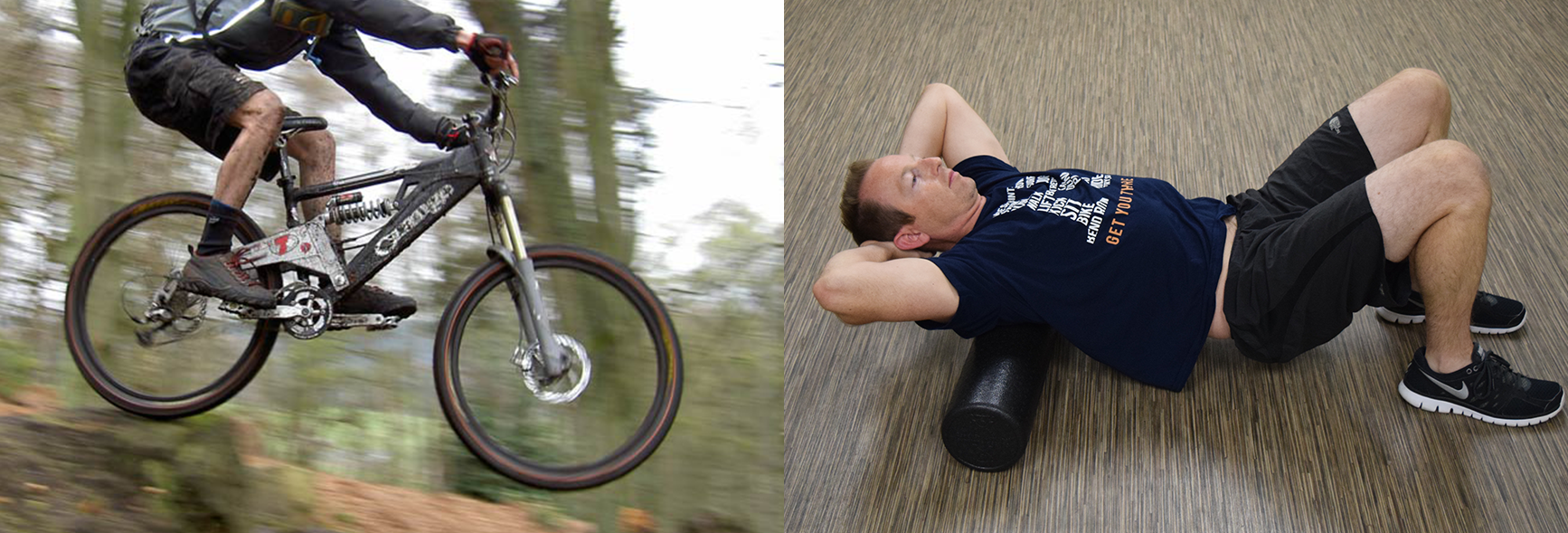
As mountain bikers, we put our bodies through the ringer. Introducing a soft-tissue mobilization technique like foam rolling can help you avoid limiting aches and pains so you can stay on the bike longer, train harder, and reduce your recovery time.

Recovery and maintenance programs aren’t always convenient, but I personally make it a point to implement them in my training to ensure I get to join the riding group every weekend and race stronger at Over the Hump. The daily grind takes a big toll on our bodies and will cause imbalances, whether it’s from poor posture at your desk, lack of cross training or focusing too much on strength training. This is why it’s critical for all MTB riders to actively pursue some form of mobility maintenance routine to keep their bodies balanced and their seat on the trails.

Best Foam Rolling Routines for Mountain Bikers

When you feel sore after you train hard or go for a long ride, it’s because your muscles are literally tearing apart to restructure fiber alignment for greater tolerance to that stress. This microfiber tearing will cause a formation of more cross-links so that you become stronger (Good!) However, if you don’t then work on those specific tissues after training—say, with a foam roller—they’ll become glued down in a mal-aligned direction, and you’ll lose mobility (Bad.)

The foam roller is one of my favorite tools for working out your muscle and tissue on a routine basis; it’s cheap, easy, and you can do it yourself. Ideally, you should spend time working out the tissues that are tight for five to 10 minutes daily, or until you feel about a 50% reduction in pain. After a long ride, you should also spend a little extra time focusing on the areas you worked hard.

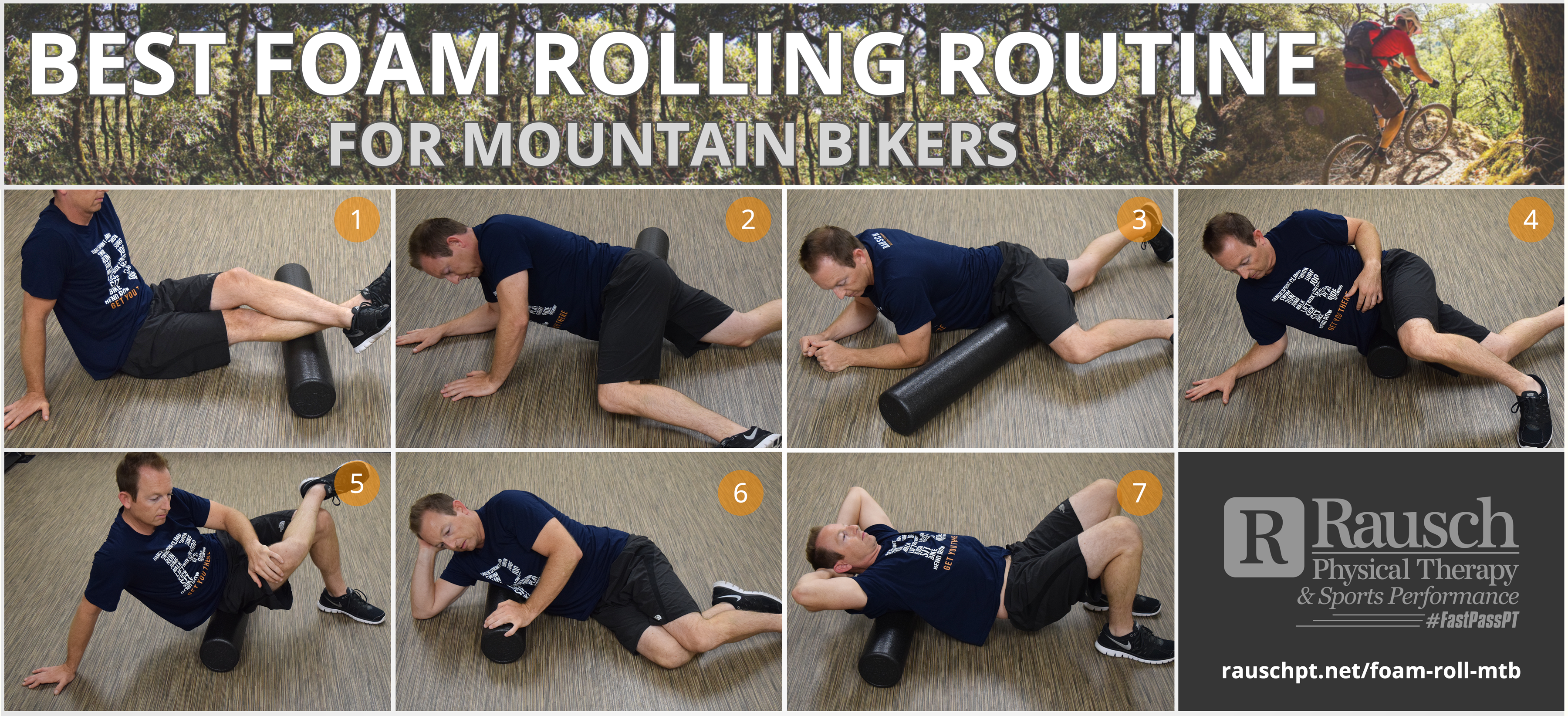
Here are the muscles I specifically attack with the foam roller after every mountain bike ride:

rauschpt.net/foam-roll-mtb
Click to enlarge
  1. Calf muscles
  2. Quadriceps
  3. Groin
  4. Tensor fasciae latae (TFL). Helps work the IT band and hip flexor complex)
  5. Gluteals/piriformis
  6. Latissimus dorsi
  7. Thoracic Spine extension. Great for avoiding the dreaded Rounded Shoulder posture.


* PRO TIP: When foam rolling, focus on going across the tissue fibers (i.e. laterally rather than up and down.) This lateral rolling will emphasis on “going against the grain” and most mimics a manual therapy technique called cross friction. This will restructure the muscle fiber alignment and keeps things sliding-and-gliding freely.

By incorporating the foam roller into your daily routine, you can reduce your risk of injuries, improve recovery time and overall athleticism—best of all, it will help you feel less old! So be specific, be consistent, and respect mobility with cross friction-based foam rolling.

This post has an accompanying article, “This Soft-Tissue Maintenance Routine Will Keep You On Your Bike Longer.” Click here to read it now on the Over the Hump blog.

DustinDustin Hancock, DPT graduated from San Diego State University with a bachelor’s degree in kinesiology/nutrition. He went on to receive his doctorate in physical therapy in 2011 from University of St. Augustine, and began his career at Rausch Physical Therapy and Sports Performance in 2012. As a snowboarder and mountain bike enthusiast, Dustin specializes in treating extreme sport athletes. As a physical therapist, Dustin says he looks forward to being a companion every step of the way on his patient’s path to recovery.

Click to learn more about Dustin and our other physical therapists »

Four Strength Exercises All Baseball Players Should Add to Their Training Program

JM-BLOG
BY JONATHAN MELTZER, DPT, RAUSCH PHYSICAL THERAPY

In my blog “How to Keep Injuries from Killing Your Big League Dreams,” I discuss four ways youth baseball players can take better care of their bodies and get in the most efficient shape possible so that injuries don’t keep them from playing ball at the next level. One of these ways is to implement a global strength program into your training regimen, which emphasizes building entire body strength rather than simply focusing on your throwing arm.

The Best Exercises for Building Entire-Body Strength

A proper strength training program will not only will this improve your overall athletic performance, but it will also help you to avoid the common overuse injuries that are plaguing youth sports today. However, I’m not just talking about strengthening the arm, but rather the entire body. I really can’t emphasize enough how important it is for baseball players to work on their shoulder stabilizers to improve their back, core and lower-half strength, as well as balance.

Here are my four favorite stabilization and strength training exercises for preventing injuries:

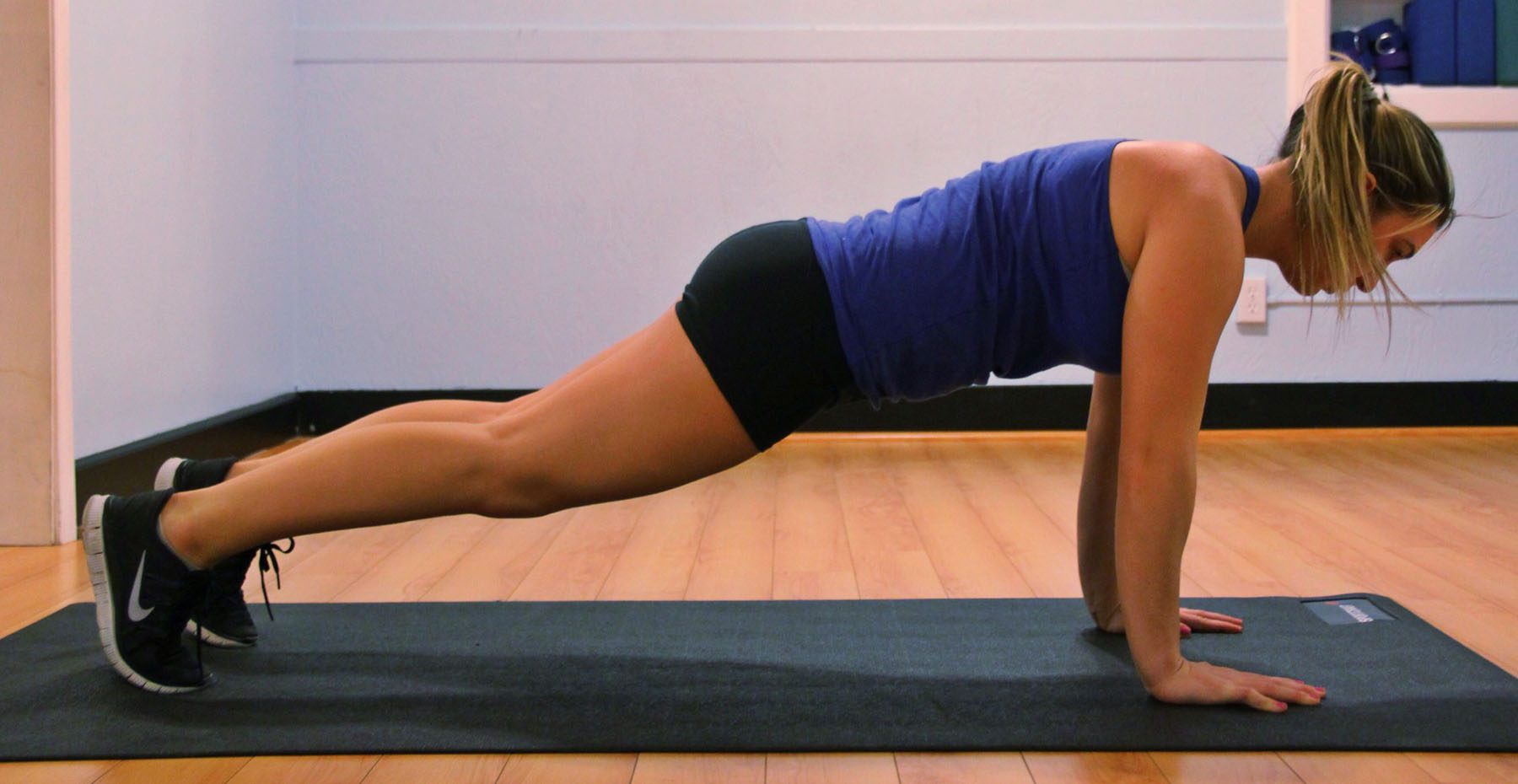
1. Planks

Planks are great for total body stabilization and core. Perform this plank series every day to increase your strength.


Front Plank – Hold for 45 seconds.


Side Planks  – Hold for 45 seconds on each side.

2. I.T.W.Y. on Swiss Ball with Weights

For this exercise you’ll need 1, 2 and a 3 lbs. dumbbells and a swiss ball. As you move through the sequence below, keep your abs tight and lifted so your back is flat. Perform 2 sets x 15 reps (2 x 15).


” I – 3 lbs. weight”


” T – 1 lbs. weight”


” W – 2 lbs. weight”


” Y – No weight”

3. Side-Lying Dumbbell Pyramid

To perform this series, lay on your side with 1, 2 and 3 lbs. dumbbells in front of you. Place a rolled towel between on your side and top arm, just below the elbow. Grab the 3 lbs. dumbell first, and lift up and down, keeping the elbow glued to the hip and shoulder blades squeezed together. Do 30 lifts or until fatigue, then move to the next lowest weight, repeating the same movements. Once you have completed reps with each dumbbell, roll over and do the other arm.


3 lbs. weight first.

lbs. weight.


Finish up with the 1 lb. weight, then switch sides.

4. Swiss Ball Core Series

This tricky series will strengthen your core and improve your balance.


Roll down the ball until you’re in a plank position, then do a push up. (2 x 15)


Tuck knees toward your chest. (2 x 15)

Core Series

Lift your hips into the pike position. (2 x 15)

By implementing these four exercises into your current strength training program, you can begin to greatly improve your entire-body strength and stability, two very important keys to athletic success and a long, healthy baseball career.


StaffHeadshot-JonJonathan Meltzer graduated from the University of Redlands with a bachelor of arts in biology and a minor in physical education. Following graduation, Jonathan discovered his passion for physical therapy while working as a Physical Therapy Aide. After graduating top of his class from Loma Linda University in 2012 with a Doctorate in Physical Therapy, Jonathan began his career at Rausch Physical Therapy and Sports Performance. Jonathan’s goals are to identify limitations and treat his patients with the most recent and innovative techniques in order to maximize functional independence and obtain his patients’ individual goals.

July Workshop: Preventing Running Injuries


Breaking the Cycle of Injury

How You Can Prevent Running Injuries for Good

[framedbox][one_third]

When

Wednesday, July 27
7 – 8:30 PM

[/one_third][one_third]

Where

RauschPT-Logo-2015

28202 Cabot Rd. Suite 150
Laguna Niguel, CA 92677

[/one_third][one_third_last]

Cost

$15 per person

[button link=”https://clients.mindbodyonline.com/classic/ws?studioid=18756&stype=-106&sView=day&date=07/27/16″ size=”small” color=”blue” align=”center” target=”_blank” ]SIGN UP NOW[/button]

[/one_third_last][/framedbox]

We get it; when you’re a runner, there’s nothing worse than suffering an injury that keeps you from doing what you love. Did you know 85% of runners get injured at least once during a year? Did you know you DON’T have to be one of them??

Click to enlargeThe July Wellness Workshop features two of our own, Performance Lab Director Jen Hollingsworth and running-PT Jessica Snyder. Jen is an elite ultra/trail running athlete and Healthy Running Coach, while Jessica, DPT, CSCS is a former collegiate track star and Natural Running Coach. This dynamic duo will explain how runners can break the cycle of injury and significantly reduce their risk of injuries through evaluation, assessment and intervention.

Topics include:

  • The three “non-negotiables” every runner needs to combat injury
  • Identifying any muscular imbalances that may be impacting your running
  • Specific exercise programs and run form tips to reduce injury risk and improve performance

So lace up your running shoes and join us at the clinic on July 27 and learn how you can continue to run—pain free—for a long, long time.

 [button link=”https://clients.mindbodyonline.com/classic/ws?studioid=18756&stype=-106&sView=day&date=07/27/16″ size=”small” color=”blue” align=”center” target=”_blank” ]SIGN UP NOW[/button]


How to Avoid and Manage Arthritis in Your Knee

SEAN
BY SEAN SWOPES, DPT, RAUSCH PHYSICAL THERAPY

The term arthritis, or more specifically Osteoarthritis (OA), refers to degeneration of the articular cartilage of the knee. While OA is most commonly associated with knee pain in 40-60 year olds, it is not something specific to old age. In fact, most people—regardless of their age—have some form of OA, but it’s the severity that usually determines the onset of pain.

What causes arthritis in the knee?

Photo Credit: AAOS OrthoInfoMost of the body is comprised of cartilaginous tissue, and having arthritis means that that cartilage is breaking down. When you have OA, the “hyaline cartilage” at the end of the long bones in your leg (Tibia and Femur) is breaking down. Healthy hyaline cartilage provides cushion to long bones and provides a smooth surface for movement to occur; in appearance, this tissue is very white and smooth. In contrast, degenerative hyaline cartilage appears red and irritated.The breakdown of this articular cartilage leads to excessive wear and tear on the joint, causing inflammation, which ultimately results in pain.

OA can also form through injury to the intra-articular (joint) surface of the knee. Injury to the (tibiofemoral) joint can lead to bleeding within the joint, which leads to further degeneration of the knee.

How can I avoid arthritis in the knee?

While many people may think arthritis is just a part of growing old, there are steps you can take to help minimize the risk of arthritis effecting your knee or your quality of life.

Improve strength in your core, not just your legs

Since humans walk upright, our pelvic and core stability can determine the effectiveness of those knee stabilizing muscles. Hip strengthening exercises can improve the stability of the legs and decrease abnormal stress to the knee joint.

Activity modification

If you knee is painful and inflamed, switch to lower impact activities. For example, if running is irritating your knee, go for a swim or bike ride instead; these two activities still allow for good cardiovascular training but decreases stress to the knee.

Strengthen your legs

The body adapts to the daily stress we place upon it. While we can often tolerate our day-to-day routine without over-stressing our knee, we are all one-weekend-trip-at-Disneyland away from causing damage to the knee joint. As simple as it sounds, strengthening the muscle surrounding the knee can help to reduce the risk for arthritis. The goal of strengthening is to place the load into the muscle, which takes the stress away from the knee joint.

Four ways to improve arthritis-related pain and function

While unfortunately this condition is degenerative and non-reversible, those who are diagnosed with OA can still address limitations to improve knee function and manage pain. Four ways to improve function with OA-related related pain include:

1. Adequate range of motion (ROM)

Home Exercise Programs: The Key to Recovery

LF-BLOG
BY LYNDSAY DEFILIPPO, DPT, RAUSCH PHYSICAL THERAPY

If you have ever undergone physical therapy, chances are that at one time or another you have received a home exercise program (HEP) from your therapist. As a physical therapist, I do my best to stress to my patients how crucial HEPs are to their recovery, but despite my best efforts I’ve found that only a small percentage of patients ever complete their program. And I get it! The whole reason you schedule a PT appointment is so you can focus on your recovery for a solid hour because outside those clinic doors you have a busy life and schedule. Sure you’ll plan to do your HEP after work, or after you put the kids to sleep, or before bed, or you’ll wake up early tomorrow… but slowly it disappears off the “to-do” list. Unfortunately when that happens, your recovery ebbs and flows instead of you making continued progress.

So, stop sabotaging your recovery! Completing your HEP will aid in a quicker, more successful long-term recovery. Once you’ve decided to commit yourself to your health, wellness and recovery, it’s actually very easy to incorporate a program into your daily routine, even with the busiest of schedules and with little to no equipment.

I’ve made a list of the four most common HEP-related complaints I hear on a daily basis, as well as some accompanying tips and tricks on how to stay compliant with your HEP simply by getting creative and making the choice to commit to YOU!

Complaint 1: I don’t have time to perform the program every day.

Solution: Incorporate portions of your program throughout your day.

If you don’t have time to complete all your exercises in one sitting, try spreading them throughout the day instead. Practice your single leg balance, heel raises, toe yoga, arch lifts, etc. while brushing your teeth. While you’re waiting in line for your morning coffee, stuck in traffic, or taking a break from the computer, do your chin tucks, neck stretches, or shoulder squeezes. If you’re a student and are unable to participate in the demands of gym class or sports because of your injury, perform your home program during practice/class time. Finding those little spaces in your day to sneak in an exercise or two will ensure you are keeping up with your program—without jeopardizing your free time.

Complaint 2: There are just so many exercises…

Solution: Ask your PT to prioritize your exercise list.

As you get better and are able to do more, your HEP also progresses and consequently might seem more lengthy than it was in the first few sessions. I find that a huge list of exercises often gives patients anxiety, which is one of the reasons I tend to start my patients off with two to three exercises, then build accordingly. Although the basic fundamentals are always important as they are your building blocks, you can discuss with your therapist the most important exercises for you to complete at your current status and break them up throughout the day.

Complaint 3: How am I supposed to perform the exercises if I don’t have the equipment!?

Solution: Not all exercises require the exact equipment we have at the clinic—get creative!

By substituting in household items, you can still target certain muscle groups and movements and ensure you continue making progress without any clinical equipment. For example:

Clinic Equipment Household Substitute
STRETCH OUT STRAP Yoga strap, dog leash, belt from a bathrobe, regular belt, or long beach towel
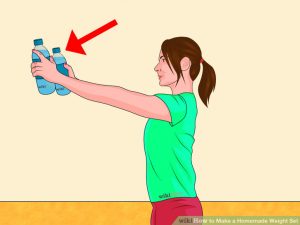
1 LB. WEIGHT Full water bottle or soup can
CABLE COLUMN Resistance bands strapped over a door
FOAM MAT Bath towel folded multiple times or a pillow on a carpeted or secure surface
(Avoid placing on slick surfaces to decrease your chances of slipping!)
CUFF WEIGHT Insert a soup can or other weighted object in a purse or small bag; hang off your ankle for leg lifts, knee extensions, etc.
SLIDERS Washcloth or towel on a hardwood floor
CALF SLANT BOARD Using a yoga strap/leash/belt/towel, perform the calf stretches in sitting position

**IMPORTANT** As with all exercise safety, please ask your therapist if you can substitute equipment, as this blog is only a recommendation and does not apply to all medical cases.

Complaint 4: I’m going on a work trip/vacation, so I won’t be able to do my HEP

Photo Credit: WikiHow
Solution: Home exercise programs are designed to be done anywhere.

Most clinics will give you a print out of your home exercise program sheet, or in our clinic’s case, make it accessible online at homeprograms.net. This means that your HEP is accessible anywhere.The substitutions above are also great ways to stick to your program while you’re traveling, as most hotels offer water bottles, bathrobes with belts, towels, etc.

With summer coming up, incorporate and utilize your environment.

  • If your family lives in the pool all summer… Ask your PT if you would benefit from a water program.
  • Heading on a tropical vacation? Sand acts as an unstable/uneven surface to promote balance and proprioceptive training.
  • If your trip requires a long flight… It’s always good to incorporate a program to avoid prolonged sitting and potential for blood clots, such as frequent walking breaks, ankle pumps, heel raises, marching in place, etc.


BONUS QUESTION! BUT, if I were to purchase items, which do you recommend most?

Depending on the injury you are recovering from and the outlined program that your PT has developed for you, a few must have items I would recommend for continued health include:

  • Foam roller
  • Lacrosse ball
  • Stretch out strap
  • Portable resistance-style bands

At the end of the day, your PT cares about your recovery and s/he would not personally create your individualized home program if s/he didn’t think it would be beneficial. It’s important to also invest in your health and take all aspects of recovery seriously. Like all things, once you make the changes and incorporate your exercises into daily life, it will become routine and therefore easier to adhere to on a daily basis. You will also reap the rewards, and return to the things you love most that have inevitably been altered since your injury.


StaffHeadshot-Lynds
Lyndsay DeFilippo PT, DPT, CKTP received her Doctorate of Physical Therapy from New York University in 2010. She’s a Graston Practitioner and a Certified Kinesiotaping Practitioner. Lyndsay looks at each injury as a constantly changing puzzle, which is only solved when her patient returns to what s/he loves doing. She enjoys helping with the full recovery process, which includes providing the education, tools and fundamentals to prevent re-injury and the potential for new injuries.

Click to learn more about Lyndsay and our other physical therapists »


Client Spotlight: Todd Clarke


After falling from 14 feet in the air, Todd Clarke was quite lucky to be alive. It was the following series of happenstance that led Todd to his perfect physical therapist, and with that a renewed appreciation for his body and its wellness.

On December 3, 2015, Todd Clarke was hanging Christmas lights on the roof of his Laguna Niguel home when an ill-fated step sent him plummeting to the ground. Luckily Todd survived, however he did suffer a concussion, tears in his shoulder, and about 30 bone fractures in both wrists and thumbs, face, skull and spine. After surgery and an eight-day stay in the hospital, Todd, a husband and father of two, was just grateful to be home in time for Christmas. Still, the accident left him unable to drive or go back to work as a teacher and multi-sport coach, and all together Todd was on disability for five months.

At about six weeks after his accident, Todd started physical therapy out of his orthopedic doctor’s office, focusing on treatment to restore function in his hands and shoulder so he could begin to take care of himself again. However, as time went on the nature of Todd’s true injuries became more apparent and unpredictable, and his focus shifted from his obvious hand and wrist injuries to the pain and stiffness in his neck and back. He also began experiencing vertigo, as the concussion he suffered caused lingering issues in the form of BPPV. Todd says that the “ever-changing landscape” of his injuries required a change in PTs, since his previous PT didn’t have a neck or back specialist on staff.

So, as soon as his hand and wrist function improved, Todd hopped on his computer to research local physical therapy clinics, which is when he stumbled upon Rausch Physical Therapy & Sports Performance. With seven physical therapists on staff, Todd had a 14% chance of being matched with Ashley Heller, MPT, but Todd says he’s glad he wound up on her table by happenstance.

It was seemingly an innate connection that led the two down a path of discovery littered with fun coincidences: Ashley had attended sixth grade at the same school where Todd was a fifth grade teacher; both attended UCSD and have a passion for surfing; they even share the same birthday!

“If Ashley was not friendly and thoughtful, we would have never had the conversations that led us to discover these wonderful connections,” Todd said.

Fueled by their fateful bond, these two kindred spirits have been hard at work to get Todd back to 100%, although with the multitude of his injuries Todd says this will likely take at least a year to fully recover. However, Todd has made great progress in just a short time; in the two months since starting treatment with Ashley, Todd says he hasn’t had any dizziness or balance issues from BPPV, which has allowed him to do what he loves most: spending time with his wife and two children. Todd is also back to doing most of the activities he enjoys, such as golfing, surfing, hiking, playing guitar and volleyball—and yes—even doing a few handy projects around the house.

“The best part [of PT at Rausch Physical Therapy] has been seeing positive results in my body and awakening the desire to be physically fit again,” he said. “Ironically, I am more active and feel healthier than I have in 10 years.”

In the end, Todd is lucky he survived his fall, it was chance he was matched up with his PT Ashley, and we’re very fortunate to have him as a client and to be a part of his recovery written in the stars.

“Heaven forbid it, but if I ever need PT again, Rausch PT will be the first place I go and I’ll look forward to going… as strange as that sounds.”

So, You Want to Be a Physical Therapist?

Blog-Jess
BY JESSICA SNYDER, DPT, RAUSCH PHYSICAL THERAPY

Hi, I’m Jessica, and I’m a doctor of physical therapy.

Jess-DPT
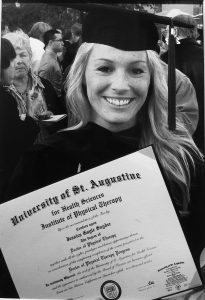
Rausch PT physical therapist Jessica Snyder receiving her doctorate in physical therapy in 2012.

As a licensed DPT, I treat many high school-aged patients (or their parents) who will often ask me what it takes to become a physical therapist. Since June is graduation month and there are thousands of high school students out there wrapping up one chapter of their life and looking to the next, let’s talk career planning and professional education for the field of physical therapy.

The Path to Becoming a Physical Therapist

Before you can even start down this career path, you must first complete your undergraduate education. After that, you’re on to… yep, more school! “PT school” is a graduate-level program that typically takes three years to complete. However, just like any other graduate program, getting in to PT school is a tough process. So, set yourself up for success and research the requirements for different PT schools while you’re still an undergrad.

Generally, all PT schools will require:

  1. Bachelor’s Degree
  2. Prerequisite Courses

Again, PT school is a graduate level, doctorate degree, so upon graduation, your formal title is “Doctor of Physical Therapy.” It is not a PhD.

Picking the Right Major for Your Future

The undergrad years are essentially “prep time” for anyone who is PT school-bound (or Physician’s Assistant school or Med school, for that matter.) You’ll spend your first few years completing your general education courses, and then you’ll move on to any and all courses required for your declared major.

As far as PT school is concerned, certain undergraduate degrees will transfer better than others into a graduate-level physical therapy program. For instance, most of the required PT school courses are already built in to an Applied Health, Kinesiology or Athletic Training/Sports Medicine major. So, of those three, which should you pick?

Applied Health

Essentially, pre-med. Applied Health is a great major if you think you may be interested in becoming a nurse (can be a undergrad/grad combo), occupational therapist (Master’s Degree), physician assistant (Master’s Degree), or some other healthcare profession (e.g. pharmacology, radiology, etc.) Pro: you have so many options and opportunities for grad school! BUT, you do have to go on to grad school. Applied Health is pre-med—something else has to follow 🙂

Kinesiology

Kinesio is a bit more targeted in your professional career options, but the coursework is not as demanding as Applied Health (there’s less emphasis on the “hard sciences.”) This would be a good option if you think you may want to go into biotech, product development or prosthetic device/adaptive equipment design. You could also go into teaching at the high school-level, however this would require that you complete a credentialing program (another two years of schooling after undergrad.)

Athletic Training

The biggest advantage to completing an Athletic Training Education Program (ATEP) is the amount of on-field, clinical experience you get as a student. You are hands-on with athletes and patients from the start, learning valuable evaluation, assessment and treatment skills , plus you get to spend less time in the lab and more time on the field! Pros: When you graduate, you can start working (and getting paid!) right away; you can work with sports teams at the high school, college, or professional level, or you can work in a PT clinic, hospital, or sports performance facility. Many ATEP graduates take the national board exam to become certified athletic trainers, which is something I highly recommend as it makes you more desirable both as an employee and as a PT school applicant.

The overarching “pro” of all of these majors is that you know that the majority of PT school prerequisites are already built into your undergraduate degree. Just remember that there may be a few classes that you will need to take as electives.

Planning for Prerequisite Courses

Every PT school has its own prerequisite coursework listed as a part of their application criteria, so check those lists and make sure you take all the necessary classes to avoid having to take those classes after you graduate (i.e. at a local junior college) before being able to apply to grad school. The Physical Therapy Centralized Application Service (PTCAS) website is a good tool for researching the general classes required by the majority of PT Schools (e.g. Anatomy, Physiology, one year of Chemistry, one year of Physics, certain psychology classes, etc.) so get organized early to ensure you at least take these classes. However, don’t forget to also check the program websites for your PT School(s) of choice to see if they might require some additional coursework. For instance, some schools require Trigonometry, while others are satisfied with College Algebra, so make sure you check!

Actions Speak Louder than Transcripts

While signing up for the right class or major can boost your chances of making it into PT School, your attitude and actions will inevitably decide whether you get that doctorate degree or not. As someone who’s been down this path before, here are my last bits of personal advice for realizing your dream of becoming a licensed doctor of physical therapy.

Graduates

  • Go the extra mile. PT school (well, graduate school in general) is getting more and more competitive! Take every opportunity to participate in research, internships, and volunteer opportunities to make yourself a more desirable candidate.
  • Be memorable and recommendable. You will need letters of recommendation from your professors and employers when applying to PT school, so earn them! Work hard, network, and stand out (in a good way.)
  • Act with your future in mind. In any healthcare field you must qualify for licensure, and all accrediting/licensing bodies—federal and state—will perform thorough background checks. Drug and alcohol use/violations, such as DUIs, are not taken lightly and can delay or even prevent you from receiving your license. Have fun in college, be “well-rounded,” but DON’T be stupid.
  • Think before you post. In our current time of social media, it’s good to remember that what happens on the internet, stays on the internet (Yes, even Snap Chat!) Trust me, I didn’t just make this up, I have friends in high tech places who will tell you that everything on the internet lives forever. Is it your dream to be a licensed doctor of physical therapy? Then keep that in mind when posting on social media.


StaffHeadshot-Jessica copyJessica Snyder (PT, DPT, ATC, CSCS) received her Doctor of Physical Therapy degree at the University of St Augustine for Health Sciences – with an emphasis on orthopedics, movement science, and manual therapy. Jessica started her career as a Certified Athletic Trainer working with high school, college and professional athletes. She is also a Certified Strength and Conditioning Specialist (enhancing her ability to build custom strength, stability and performance-centered rehabilitation and return-to-sport programs) and Certified Natural Running Coach. Being a runner herself, Jessica specializes in running-related injuries, including the entire lower extremity. She is also passionate about treating headaches and neck/shoulder pain.

Click to learn more about Jessica and our other physical therapists »