

Rausch Physical Therapy & Sports Performance — Laguna Niguel • Dana Point • Mission Viejo
Ask any golfer in South Orange County what they’d trade for 15 more yards off the tee and a round without back pain, and the answer is usually “almost anything.” Here’s the part most golfers miss: those extra yards aren’t hiding in a new driver. They’re locked up in your hips, your mid-back, and your core.
Your swing can only be as good as your body allows. At Rausch Physical Therapy & Sports Performance, our Doctors of Physical Therapy look at your body the way a coach looks at your swing — finding the tight, weak, or unstable links in the chain that are quietly costing you distance, consistency, and comfort. Pair that expert care with our StretchFix assisted stretching program, and you have the same one-two punch the pros use: build the movement, then keep it. Here’s how it works.
“Golf is family time for me — most weekends you’ll find me out on the course with my son and daughter. And I’ll tell you what I tell every golfer who walks into our clinics: the best piece of equipment in your bag is a body that moves well. Take care of your mobility and strength, and the game takes care of itself.”
— Kevin Rausch, PT — Founder, Rausch Physical Therapy & Sports Performance
How Can I Improve My Golf Swing With Better Mobility and Strength?
A powerful, repeatable golf swing is a full-body rotational movement. You coil against a stable lower body, store energy through the trunk, and release it in sequence. If any link can’t do its job — hips that won’t rotate, a stiff thoracic spine, a core that can’t transfer force — your body compensates somewhere else. That’s where slices, inconsistency, and injuries are born.
How Physical Therapy and StretchFix Improve Your Swing
This is where Rausch PT is different from a gym program or a YouTube stretching routine. Your Doctor of Physical Therapy starts with a hands-on movement assessment — hip rotation, thoracic mobility, shoulder range, single-leg stability — and pinpoints exactly which restrictions are shaping your swing. Then you get a personalized plan of hands-on treatment and targeted exercise, with your therapist beside you the entire session, every session.
Then StretchFix keeps the gains. In a one-on-one assisted stretching session designed by our Doctors of Physical Therapy, a trained practitioner moves your hips, hamstrings, shoulders, and spine through ranges you simply can’t reach on your own — the maintenance side of the equation that keeps your new mobility from stiffening back up between rounds.
Why Improved Mobility Means a Better Golf Swing
- More hip and trunk rotation = a bigger shoulder turn — a fuller backswing stores more energy, which converts directly into clubhead speed and distance.
- Better separation between hips and shoulders — the famous “X-factor” that lets you sequence the downswing properly instead of swinging all-arms.
- Stable ankles and hips = a consistent base — better balance through the swing means better contact, round after round.
- Free movement = no compensation — when your body isn’t fighting its own restrictions, your swing coach’s changes finally stick.
Can Stretching and Strengthening Really Help My Golf Swing?
In a word: yes — and it’s one of the best-documented ideas in golf fitness. Golf-specific mobility and strength programs are the backbone of how touring professionals train. Amateur golfers who improve rotational mobility and core strength routinely see faster clubhead speed, better ball-striking consistency, and dramatically fewer aches after 18 holes.
How Rausch PT and StretchFix Help Golfers Get Better
Think of it as a team approach to your golf body. Physical therapy identifies and fixes the problems: restoring lost joint motion with hands-on care, then strengthening the new range so it holds up under a full-speed swing. StretchFix maintains and extends the progress — regular assisted stretching sessions that keep your hips, spine, and shoulders moving freely all season long. Golfers who combine the two don’t just get out of pain; they build a body with more swing in it.
The Key Muscles (and Joints) We Target for Golfers
- Hips and glutes — the engine of the swing; internal hip rotation is the single most common restriction we find in amateur golfers.
- Thoracic spine (mid-back) — where your shoulder turn actually comes from; desk jobs lock it up and swings suffer.
- Core and obliques — transfer power from the ground to the club and shield your lower back from rotational stress.
- Lats and shoulders — control the club at the top of the backswing and through the release.
- Hamstrings and calves — maintain your posture and spine angle from the first tee to the 18th green.
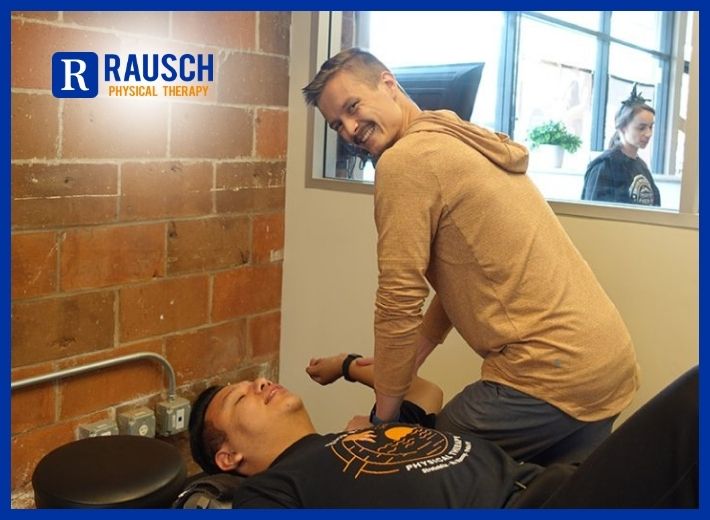 Lower Back Pain After Golf: Causes and Fixes
Low back pain is the most common complaint in golf, at every age and skill level. The swing puts enormous rotational and compressive force through the lumbar spine — up to eight times body weight at impact by some estimates — and it repeats that force 70 to 100 times a round, plus practice swings.
The Usual Suspects
- Stiff hips and mid-back — when the joints built for rotation won’t rotate, the lower back (built for stability) is forced to do it instead.
- A weak core and glutes — without a strong trunk and hip engine, the small muscles of the low back absorb forces they were never designed for.
- Muscle imbalance — golf is a one-sided sport; hundreds of swings in the same direction create asymmetries that pull on the spine.
- No warm-up, no stretching — walking straight from the car to the first tee is the most common back-pain recipe we see.
Sample Stretches and Fixes You Can Start Today
- Open books — lie on your side, knees bent, and rotate your top arm open; 10 per side for thoracic rotation.
- 90/90 hip switches — seated, rock both knees side to side to restore hip internal rotation.
- Glute bridges and bird dogs — wake up the glutes and deep core that protect your spine.
- Standing trunk rotations with a club across your shoulders — grooves rotation through the right joints.
If back pain is already following you home from the course, don’t stretch blindly at it — get it assessed. Your Rausch PT evaluation will tell you exactly why your back hurts and what will fix it — and because California allows direct access to physical therapy, you don’t need a physician referral to get started in most cases.
A Golf-Specific Warm-Up to Add Distance and Reduce Injury Risk
Research on golfers consistently shows that a proper dynamic warm-up improves clubhead speed and cuts injury risk — yet most amateurs skip it entirely. Ten minutes before your round is all it takes:
- Brisk walk — 2 minutes, from the parking lot or around the range, to raise your core temperature.
- Leg swings — 10 forward/back and 10 side-to-side per leg for the hips and hamstrings.
- Hip circles and lunges with rotation — 8 per side to open the hips and turn on the glutes.
- Standing open books / trunk rotations — 10 per side to unlock the mid-back.
- Arm circles and shoulder crossovers — 15 each to prep the shoulders and lats.
- Wrist circles and forearm stretch — 30 seconds; your elbows and wrists take more load than you think.
- Progressive practice swings — start at 50% with a short iron, build to full driver speed over 8–10 swings.
Want the warm-up to actually have range of motion to work with? That’s the StretchFix effect. Golfers who come in for a weekly StretchFix session start their rounds with looser hips and a freer shoulder turn — so the first tee shot looks like the tenth. Book your session here.

FAQs: Golf, Mobility & Physical Therapy at Rausch
I’m not injured — can I still see a physical therapist to improve my golf game?
Absolutely. Performance-focused physical therapy is one of the smartest investments a golfer can make. Your therapist will assess your swing-relevant mobility and strength and build a plan to add range, speed, and consistency before pain ever shows up. Book an evaluation here.
What’s the difference between physical therapy and StretchFix?
Physical therapy is one-on-one care from a Doctor of Physical Therapy — assessment, hands-on treatment, and a personalized exercise plan to fix a problem or build performance. StretchFix is our assisted stretching program, designed by those same Doctors of Physical Therapy, focused purely on improving and maintaining your mobility. Many golfers use both: PT to fix, StretchFix to maintain.
How often should a golfer do StretchFix?
Most golfers do great with one session per week during the season. If you’re working through a mobility restriction or playing several rounds a week, your practitioner may suggest twice weekly to start.
Do I need a referral to start physical therapy at Rausch?
In most cases, no — California is a direct-access state, so you can start PT without a physician referral at any of our three South Orange County clinics: Laguna Niguel, Dana Point, and Mission Viejo.
Ready for Your Best Golf Season Yet?
More distance, a smoother swing, and a back that doesn’t complain on the back nine — your body is capable of all three with the right team behind it. The Rausch PT crew can get you there.
“My kids keep my swing honest — StretchFix keeps my back honest. If you love this game and want to play it for decades, come see us.”
— Kevin Rausch, PT — Founder
- ► Schedule a physical therapy evaluation — find out exactly what your swing needs; no referral required in most cases.
- ► Book your StretchFix session — the mobility maintenance plan every golfer needs.
- ► Call us at (949) 276-5401 with any questions.
- ► Follow us on Instagram @rauschpt for weekly mobility tips, specials, and community events.
Rausch Physical Therapy & Sports Performance — helping South Orange County athletes get back to doing what they love.