
rauschpt, Author at Rausch Physical Therapy & Wellness - Page 23 of 30

Blog

Five Exercises to Increase Surfers’ Paddling Strength and Endurance

Blog-Ash
BY ASHLEY, MPT, RAUSCH PHYSICAL THERAPY

How well did your shoulders hold up to the El Niño this winter? Building strength through your shoulders and upper back to improve paddling endurance is your key to paddling out in bigger surf, catching bigger waves, and being able to stay out for longer surf sessions.

Strengthening the rotator cuff, scapular stabilizers and upper back are all key components to improve paddling strength. The rotator cuff muscles are extremely important for stabilizing the shoulder joint, which is the most mobile joint in the body. Specifically, strengthening the external rotators of the rotator cuff act to counterbalance the more dominant internal rotators (pecs & lats), minimize muscle imbalances when paddling, and promote good shoulder mechanics. Enhancing strength and endurance of the scapular stabilizers will also help you maintain good shoulder mechanics to prevent injury during extended periods of paddling.

Exercises for paddling endurance should focus on high reps and low weight, while exercises for paddling power should focus on increased weight with lower reps to maximize overall strength. As you build strength, it’s important to maintain shoulder mobility and flexibility by stretching and foam rolling before and after every session to minimize any joint stiffness throughout the shoulder and upper back, as well as to minimize muscle fatigue and soreness. Check out my previous surfing blog for the Best Foam Rolling Exercises for Surfers’ Shoulders.

Five Exercises to Target Muscles for Paddling

While the best way to gain paddling strength is actually getting out in the water, these five exercises can help compliment the work you do in the water, on dry land:

Exercise 1: Scaps Clocks

Scap Clocks

Promotes endurance of the upper back and shoulder

  • Start with the right arm. Pull tension in the band to 1 → 3 → 5 o’clock. Repeat with left arm, pull band to 11 → 9 → 7 o’clock. Make sure to keep your shoulders down and back; standing against the wall is a good cue for upright posture.
  • Perform 10-15 reps on each side.


Exercise 2: Alternating Rows with cables or bands

Alternating Rows

Promotes stabilization and endurance of the shoulder blade while paddling

  • Keeping your elbow at your side, pull the band back while squeezing the shoulder blades together.
  • Perform 2 sets of 20, increase resistance if you’re not fatigued by the end of the set


Exercise 3: Alternating Lat Pull-Downs with cables or bands

Alternating Lat Pull-Downs

Builds paddling endurance through lats for a strong pull through the water

  • Stand in a partial squat to activate your core. Pull the band down towards your hip, keeping your elbow straight. Let the tension out of the band slowly to return to starting position. Alternate arms.
  • Perform 2-3 sets of 20 on each side alternating strokes


Exercise 4: Prone external rotation/internal rotation on swiss ball

Prone External/Internal Rotation

Promotes rotator cuff strengthening while paddling

  • Lay prone on the swiss ball, keeping your back straight and chin tucked. Start with the shoulder abducted and externally rotated in the ‘90/90 position’ (as shown in photo.) Internally rotate your shoulder to simulate paddling while keeping your shoulder and elbow aligned.
  • Perform 2-3 sets of 10, add light weight (1-3 lbs. dumbells) as strength improves


Exercise 5: Simulated paddling on swiss ball with band

Simulated Paddling

  • Keep chin tucked and shoulders back and keeping your elbow straight while pulling. Slowly let tension out of band to return to overhead position, alternate arms.
  • Perform 2-3 sets of 20 on each side alternating strokes

Training to build muscle strength to help you paddle longer and faster will improve your overall surfing endurance. The best way to practice paddling is getting out in the water; these specific paddling exercises are to help compliment the work you do in the waves. See you in the water!
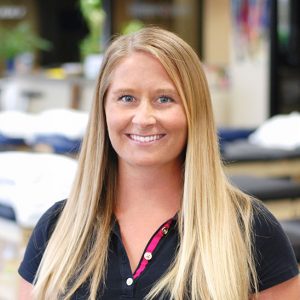


StaffHeadshot-Ashley2Ashley Heller, MPT is the newest member of the Rausch PT team. She received her Masters of Physical Therapy degree at California State University, Long Beach and is passionate about working with patients with shoulder, knee and ankle injuries. With background in orthopedic-related injuries and post-operative rehabilitation, Ashley believes that the combination of manual therapy and personalized therapeutic exercise program is vital to recovery. As a physical therapist, it’s Ashley’s goal to help her patients better understand their injuries and the plan for their road to recovery.

Click to learn more about Ashley and our other physical therapists »

Rausch Physical Therapy Celebrates 10 Years of Innovation and Growth

LAGUNA NIGUEL, CA (May 2, 2016) – Rausch Physical Therapy & Sports Performance (Rausch PT)—a leader in the physical therapy field that specializes in taking patients from injury, to recovery, to peak performance—today announces the tenth anniversary of the company’s founding.

Kevin Rausch, president and owner of Rausch Physical Therapy & Sports Performance.Rausch PT was founded in 2006 by president and licensed physical therapist Kevin Rausch when he was 27 years old. While other privately-owned physical therapy clinics have seen little-to-no growth in recent years, with many having to close their doors, Rausch PT stands out in the field thanks to its president’s unique vision for operating physical therapy practices.

Since the start Rausch has aimed to be an innovator in the field of physical therapy. Rather than rely on a broken health care system and physician referrals, Rausch wanted to provide a holistic option for rehabilitation, preventative health and wellness. After moving from a 2,000 sq. ft. suite to a 9,000 sq. ft. one, the company not only expand its physical therapy practice, but also to added an on-site, full-service Pilates studio and massage therapist wing. An on-site sports performance lab was added a couple years later, boasting the kinds of technologies that one can typically only access as a professional athlete, including an AlterG® Anti-Gravity Treadmill® and Hypoxico Altitude Training System. In ten years Rausch PT has grown from one physical therapist and 2,500 annual visits, to six licensed PTs on staff and more than 18,000 annual visits.

“Our clinic has taken the lead by not only offering the most thorough and specific rehabilitation programs in the field, but also by integrating the latest rehab technology and on-site wellness offerings that you just cannot find anywhere else under one roof,” Rausch said. “I’m proud of what we’ve been able to accomplish as a company in the past 10 years, but more importantly I look forward to continuing to expand people’s minds on what physical therapy can be.”

While most people think of hospitals and nursing homes when they think of physical therapy, Rausch PT specializes in active patients who want to get back to doing what they love, whether that be completing an IRONMAN, jogging a 5K, or simply chasing after their kids. Instead of being clinical and sterile, Rausch modeled the feel of his PT clinic after his grandfather’s sports bar—a welcoming, intimate escape for therapy.

“We’re in the business of making people feel good, and I don’t just mean their injuries,” Rausch said. “I want patients to look forward to coming here because it’s social and fun, everyone knows your name, and everyone is rooting for you to achieve your goals.”

By offering the highest quality rehab programs and latest technological advances, Rausch PT has earned its reputation as the “go-to” clinic for Orange County triathletes, runners, swimmers and cyclists, in addition to patients who live active, on-the-go lifestyles. Clients include everyone from ultra-trail runners and amateur cyclists, to weekend warriors and moms-on-the-go.


About Rausch Physical Therapy

Founded in 2006, Rausch Physical Therapy & Sports Performance in Laguna Niguel, Calif. specializes in taking patients from injury, to recovery, to peak performance. Its sport-specific, licensed physical therapists combine their expertise in human mechanics with the clinic’s innovative rehabilitation and performance technologies to help its patients stay healthy and reach their goals.

For more information, contact casey@rauschpt.net (949) 276-5401 x 106 or visit rauschpt.net.

RauschPT-Logo

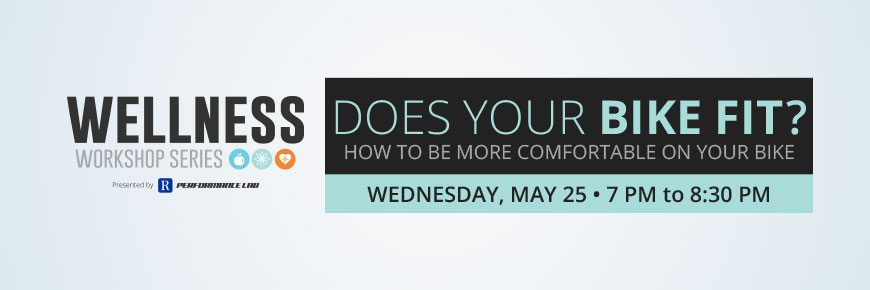
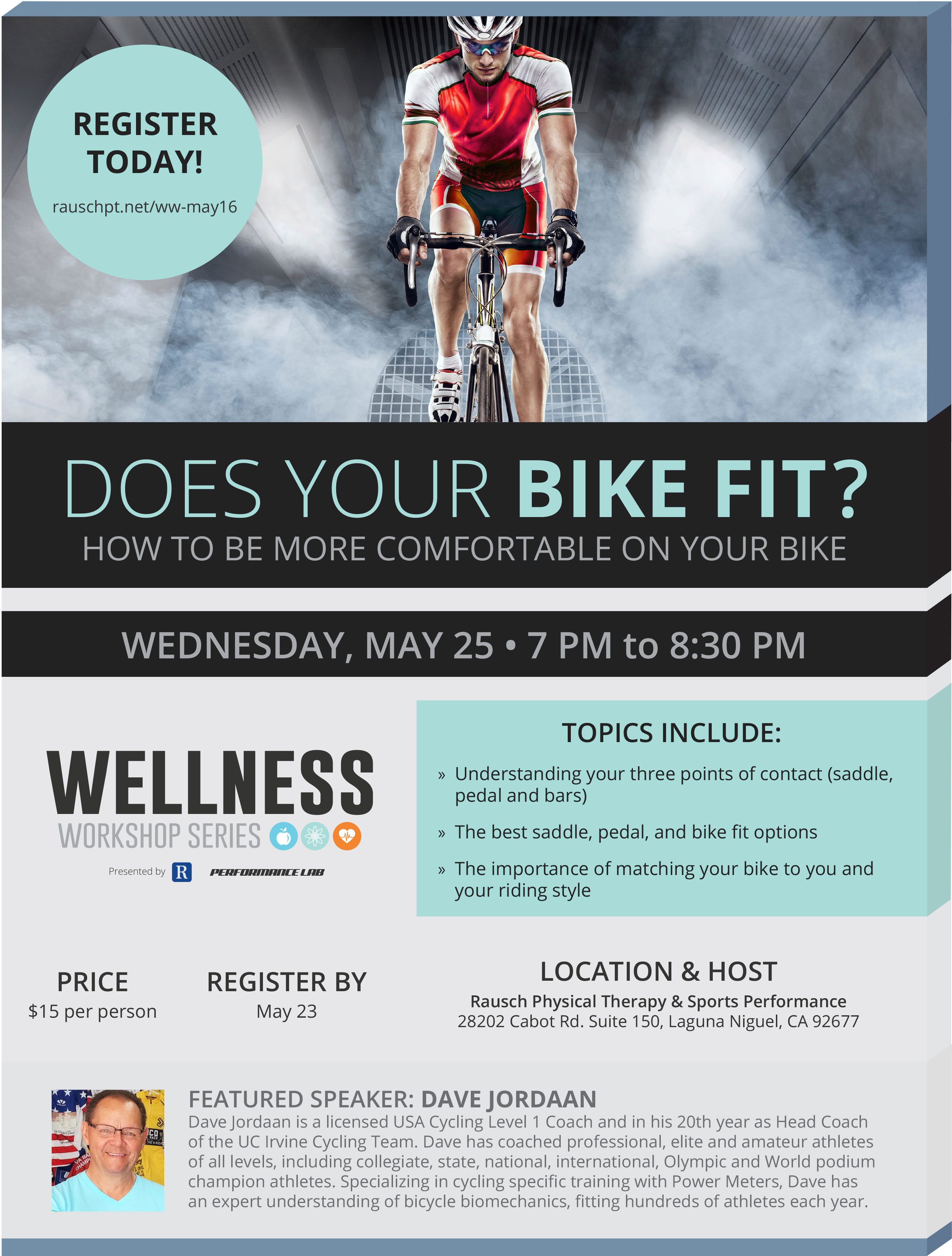
May Wellness Workshop: Does Your Bike Fit?


Does Your Bike Fit? How to Be More Comfortable on Your Bike

[framedbox][one_third]

When

Wednesday, May 25
7 – 8:30 PM

[/one_third][one_third]

Where

RauschPT-Logo-2015

28202 Cabot Rd. Suite 150
Laguna Niguel, CA 92677

[/one_third][one_third_last]

Cost

$15 per person

[button link=”https://clients.mindbodyonline.com/classic/ws?studioid=18756&stype=-106&sView=day&date=05/25/16″ size=”small” color=”blue” align=”center” target=”_blank” ]SIGN UP NOW[/button]

[/one_third_last][/framedbox]
The May Wellness Workshop features Dave Jordaan, a licensed USA Cycling Level 1 Coach and the Head Coach of the UC Irvine Cycling Team. Dave has coached professional, elite and amateur athletes of all levels, including many collegiate, state, national, international, Olympic and World podium champions; and on May 25 he will be visiting Rausch PT to teach you how to be more comfortable on your bike.

WWWMay16-Flyer
Enlarge Flyer

Participants will:

  • Hear in-depth explanations about proper bike fit from Dave Jordaan, USA Cycling Level 1 Coach
  • Learn how to avoid pain from the three points of contact (saddle, pedal and bars)
  • Learn about the best saddle, pedal, and bike fit options
  • Understand the importance of matching your bike to you and your riding style

Come join us for a night of interactive learning where you will learn how to out ride the competition and have more enjoyable, pain-free rides!

 [button link=”https://clients.mindbodyonline.com/classic/ws?studioid=18756&stype=-106&sView=day&date=05/25/16″ size=”small” color=”blue” align=”center” target=”_blank” ]SIGN UP NOW[/button]


My Own Worst Patient

Blog-Jess
BY JESSICA SNYDER, DPT, RAUSCH PHYSICAL THERAPY

A college running injury is what originally introduced me to the field of physical therapy. I remember being so frustrated that I could not run and no one seemed able to “fix” it. I was bounced around between the university’s medical staff with no resolution. It wasn’t their fault; they had a lot of athletes to cover and I simply fell through the cracks. But, I was also extremely stubborn and continued running. In pain. Because no one had a better solution.

It was finally my mom who intervened. She did some research and found a physical therapist that she thought could help me. The physical therapist was the first person who took the time to listen to my symptoms, evaluate my injury, and explain to me what was going on and what needed to be done in order to get me running again. Finally! A diagnosis, an explanation, and a plan.

That’s when I knew I wanted to become a physical therapist.

On Top of the World

When I received my doctorate of physical therapy degree, I couldn’t help but think about how I’d come full circle—how I was now going to be that person that helps someone get back to doing what they love. I felt so grateful that this is what I was going to do with my life.

Flash forward, and I’ve now been working at Rausch Physical Therapy & Sports Performance for four years. I still run daily, and I haven’t really had to deal with any of the major, sidelining injuries that plagued me back in college. I’ll admit that I started to lose sight of PT from the perspective of a patient. It took a recent personal injury to remind me why I love this field so much.

Last month I was snowboarding at June Mountain when I fell on my butt and completely threw out my SI joint. That’s when I got my worst patient of all time: Me.

The Fall

I couldn’t walk, let alone run. Getting in-and-out of the car was terrible. I couldn’t bend down to wash off the dog’s muddy paws, and I also couldn’t mop up the floor. I couldn’t even chase after my best friend’s daughter when she took off running towards the street—half a step and shooting pain across my back.

At first, I was okay with it. As a PT, I was able to self-diagnose myself with a badly sprained SI joint, which I knew would require time for the inflammation to go down and scar tissue to form in order to stabilize it. But, this professional practicality quickly faded into personal distress. By the end of the first week, I was in the anger phase of my depression. I was constantly on the verge of tears, I was ready to give up trying to stay active, I had even convinced myself that I would never run again (Completely irrational! It had only been a week!)

Then, something amazing happened. One of my favorite parts of being a PT is chatting with my patients while I’m treating them, and inevitably my frustration with my injury came up. That’s when my patients started repeating all the things that I had at some point told them during their recovery:

“Jessica, you know tissue healing takes a minimum of four weeks.”

“Be patient, Jess! Why don’t you take this time to focus on strengthening?”

“Allow your body to heal properly; you don’t want to push it too early and create a chronic problem.”

I was transported back to that time in college, when someone was able to pull me out of my injury-induced spiral when I felt hopeless. But this time, that person was myself! Coming through my incredible patients! I was so grateful for their explanations and words of encouragement, and I was finally able to tell myself, “Pull it together and stop acting crazy!”

Getting Back Up

So, I made a plan. I started to focus on what I could do, and used this injury as an opportunity to be more creative with my exercise routine. I started to be grateful for the little things that I was slowly able to do, walk with less pain, finally lie down on my back, and almost lift my foot to put on a shoe.

Recovery is a process. As a patient, I think it’s important to know that your physical therapist has chosen their professional field for a reason: we’ve been there, we get it, and thanks to this recent fall of mine, I am more motivated than ever to get you back to feeling your best.


StaffHeadshot-Jessica copyJessica Snyder (PT, DPT, ATC, CSCS) received her Doctor of Physical Therapy degree at the University of St Augustine for Health Sciences – with an emphasis on orthopedics, movement science, and manual therapy. Jessica started her career as a Certified Athletic Trainer working with high school, college and professional athletes. She is also a Certified Strength and Conditioning Specialist (enhancing her ability to build custom strength, stability and performance-centered rehabilitation and return-to-sport programs) and Certified Natural Running Coach. Being a runner herself, Jessica specializes in running-related injuries, including the entire lower extremity. She is also passionate about treating headaches and neck/shoulder pain.

Click to learn more about Jessica and our other physical therapists »
Quick Fix for Dead Spots in Your Pedal Stroke

Blog-Dustin
BY DUSTIN HANCOCK, DPT, RAUSCH PHYSICAL THERAPY
When cycling, there are two things that can improve your velocity: power output and turnover cadence. However, the overall power output can be weakened if at some point during your pedal stroke, you have inconsistencies during that full, circular motion. Inconsistent torque forces, or dead spots, typically occur at the initiation of the upstroke. You can determine if you have dead spots by using a power meter or by doing a test like our Performance Lab’s Bike Right, but a simple indicator if your stroke has dead spots is smashing and hammering of the pedals.

Like most exercise movements, a healthy pedal stroke relies on the stretch shortening cycle (SSC) to be efficient. SSC occurs when a muscle stores elastic energy as a muscle lengthens; this stored-up energy is then used when the muscle immediately shortens. Since SSC is a myofascial and nervous system stretch reflex, if the body has adequate mobility and dynamic stiffness, the SSC will allow for any athlete to access free kinetic energy, i.e. more power for less work! Improving SSC can not only be a huge efficiency booster, it can also help improve joint stability and congruency to save those knees from arthritic changes.

Quick One-Legged Exercise to Improve Dead Spots

Here’s a great neuromuscular recalibration drill that you can do on a trainer to improve those dead spots.

Step 1: Hop on a trainer and warm up with the smooth circular stroke pattern focused on relaxing your legs especially your ankles.

Step 2: When you feel warm and ready, pick up the cadence to 92-95 rounds per minute (RPM) and take one foot off the pedal. Place that foot in the center frame.

Step 3: Maintain the cadence for 30-second intervals, working up to 90-second intervals for three to five rounds.

This exercise ensures the leg pulls up at the bottom of your stroke, allowing the hamstring to apply more power into the equation. It also improves the circular stroke pattern and gets you away from that less effective “smashing pedal” form. Try to apply this exercise to your warm up and see what it can do for your cycling efficiency and overall speed.

Enjoy one more thing to think about on your ride!


DustinDustin Hancock, DPT graduated from San Diego State University with a bachelor’s degree in kinesiology/nutrition. He went on to receive his doctorate in physical therapy in 2011 from University of St. Augustine, and began his career at Rausch Physical Therapy and Sports Performance in 2012. As a snowboarder and mountain bike enthusiast, Dustin specializes in treating extreme sport athletes. As a physical therapist, Dustin says he looks forward to being a companion every step of the way on his patient’s path to recovery.

Click to learn more about Dustin and our other physical therapists »
Coast to Canyon: Pedaling 700 Miles for Joan

Colin
BY COLIN STOKES, ULTRA CYCLIST

“Grant me the serenity to accept the things I cannot change, the courage to change the things I can, and the wisdom to know the difference”.

A mission statement for life, but often a difficult path to navigate. Having recently passed 50 years old, I still feel very much like an apprentice seeking that elusive wisdom to know the difference. As an endurance junkie and ultra-distance cyclist I seldom do things the easy way. I regularly find myself signing up for 500-mile bike races (sober.) I recently raced non-stop for 1,000 miles in Texas because—let’s face it—what middle-aged man wouldn’t want a T-shirt from an event called “No Country for Old Men?” And in 2013 I competed in the solo division of the 860-mile Race Across the West (RAW) from Oceanside, CA to Durango, CO, which follows the same desert and mountain roads as the mother-of-all endurance races: the 3,000-mile Race Across America (RAAM). RAW was an epic struggle through 125 degree temperatures in the Sonoran desert, sand blasting in the Navajo Nation, and frigid night-time temperatures across the high desert.

I ride my bike more miles in a year than many drive their car. I’ve climbed a million feet in 12 months and on the summer solstice plan to ride 40,000’ in a day (and night.) I do these things not so much because I choose to; it’s more a case of, “I have to.” An addiction that must be satiated. Once the idea starts geminating in my head, there is only way to expunge it: give in to the inevitable!

As a toddler, my Mum transported me everywhere by bike and later chaperoned me as I powered myself on two-wheels. I was 40 years old before I broke her cycling distance record for a day. It’s her genes that power my passion for the bike on a never-ending geographical, physical and emotional journey.

Now on May 20, I’ll be retracing my RAW steps. This time, instead of continuing east from Flagstaff, I will branch north to intersect the south rim of the Grand Canyon. It’s been three years so I’m just a little wiser; I’m bringing along some friends to share the wind, and we’ll be spending a few hours each night in hotels (instead of collapsed  in fetal position on the bed of my mini-van.) That said, this still won’t be a picnic. We’ll leave the pier at Oceanside, CA and ride 700 miles with almost 40,000 ft. of climbing; approximately 65 hours of riding coast to canyon. We plan to ride 300 miles the first day and then 200 miles the next two days. But, a plan is just a plan. If ultra racing has taught me anything over the years, it is to expect the unexpected and to roll with the punches that Mother Nature and the road throw in your direction.

Still, it’s reassuring to know on this particular adventure I will have a heavenly V.I.P. watching my back.

Mum lived in the tightening grip of Parkinson’s disease for more than 15 years until she passed this last Christmas. She is the reason why I am making this epic little adventure—to raise awareness and funds for the National Parkinson Foundation. It seems only fitting that I use a bicycle to raise money on her behalf.

I am proud to support the National Parkinson Foundation (NPF) and Parkinson Canada and their mission to help people with Parkinson’s live their best lives now until there is a tomorrow without Parkinson’s. I have raised almost $6,000 in a month, and I am aiming for a total goal of $15,000; that’s $21 per mile, or approximately 5 cents per pedal stroke. Donations can be made directly to NPF at the Joan Stokes Memorial Team Hope Fundraising Page.

We are who we are. A product of nature and nurture. We cannot escape our genes, and why would I want to? Pedaling for a cause just makes the adventure that much sweeter!


Client Spotlight: Robert Plumb


Physical therapy doesn’t work unless you do, a notion Robert Plumb fully embraces. Read how hard work and dedication has helped Robert stay on the path to health and wellness, despite every reason to stop.

Robert Plumb might just be one of the most active people we’ve treated here at Rausch Physical Therapy (and that’s definitely saying something.) From skiing to ice hockey to his life’s passion—cycling—Robert does it all. He takes spin class, hits the gym for high-intensity workouts, and prefers a bike over a car. To say Robert is a self-motivator is an understatement.

“I can’t just sit at home and watch TV,” Robert said. “I just like being out and active and pushing it.”

Staying so active is what helped Robert lose an astounding 120 lbs. in a year and a half; it’s also what caused Robert a broken collar bone, torn calf, two bouts of bronchitis and—most recently—a Grade 3 hamstring tear.

“[Being injured] tests you mentally and physically. I’ve been on a really solid health plan, and I just wanted to keep the ball rolling down that path.”

After his collar bone surgery, Robert had a negative experience with physical therapy from which his injury never healed properly. So months later when he tore his hamstring in December, Robert decided to drop his HMO plan and switch to a PPO so he could come to Rausch PT.

Robert was teamed up with mountain bike-PT Sean Swopes, and in true Robert-fashion, the two hit the ground sprinting. With an extremely high re-injury rate, their goal was to not just heal the hamstring tear, but also to strengthen and increase mobility (and Robert’s confidence) so as to prevent any future hamstring injuries.

“It was important to me to get back on the bike/in the gym because that’s what keeps me sane and happy. So, I worked my butt off. I got to all my PT appointments, I did all my exercises to the letter, twice or three times a day depending on my workload.”

Once again, all Robert’s hard work paid off. After three weeks, Robert and Sean hit the trails together for one final test. Robert says Sean wanted to see him in his true element, on the mountain bike, to ensure he was ready to be cleared.

“It was good to have him there, just in case. He could see how [my hamstring] reacted to standing, pedaling, going up hills… but it didn’t bug me at all. We did my stretches after our ride, and I was cleared.”

Robert says he’s thrilled how quickly this injury healed. He’s back on the bike, and says he’s looking forward to hopefully getting in a few ski sessions in before the season is over. While he says he’s playing with the idea of racing the 2017 Trans-Cascadia backcountry mountain bike race in Oregon, Robert says he knows to properly train for it he’ll have to stay healthy for the next two years (a tall order for Robert Plumb.) For now, Robert’s just glad he’s back on track to continue his path to wellness.

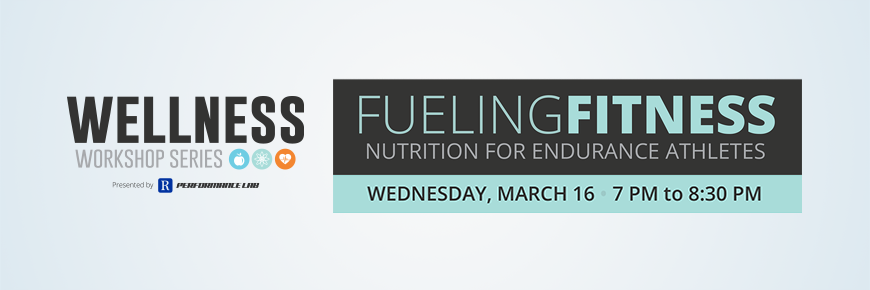
March Wellness Workshop: Nutrition for Endurance Athletes


Fueling Fitness: Nutrition for Endurance Athletes

[framedbox][one_third]

When

Wednesday, March 16
7 – 8:30 PM

[/one_third][one_third]

Where

RauschPT-Logo-2015

28202 Cabot Rd. Suite 150
Laguna Niguel, CA 92677

[/one_third][one_third_last]

Cost

$20 per person

[button link=”https://clients.mindbodyonline.com/classic/ws?studioid=18756&stype=-106&sView=day&date=03/16/16″ size=”small” color=”blue” align=”center” target=”_blank” ]SIGN UP NOW[/button]

[/one_third_last][/framedbox]
The first Wellness Wednesday Workshop of 2016 features speaker Kristin Hirahatake, a registered dietitian and accomplished runner/triathlete. Kristin will discuss the fundamentals of sports nutrition with an emphasis on diet quality for endurance athletes. Learn how to determine your individual nutrition needs and optimize your diet to better support your training and active lifestyle.

Enlarge Flyer

Participants will:

  • Hear in-depth explanations about the science behind nutrition from Kristin Hirahatake, MS, RD
  • Learn how to calculate your estimated macronutrient needs and identify healthy, nutrient-rich foods to propel your training and wellness
  • Receive step-by-step instruction and take-home guides on how to create balanced and appropriately portioned meals


Topics include:

  • Importance of diet quality for endurance athletes
  • What to eat, when to eat, and how much to eat
  • Training and race-specific hydration and nutrition strategies
  • Portion control, meal planning and weight management for athletes

Come join us for a night of interactive learning where you will learn that you are what you eat!

 [button link=”https://clients.mindbodyonline.com/classic/ws?studioid=18756&stype=-106&sView=day&date=03/16/16″ size=”small” color=”blue” align=”center” target=”_blank” ]SIGN UP NOW[/button]


Seven Myths About Physical Therapy: Debunked

KR-BLOG
BY KEVIN RAUSCH, PT, PRESIDENT OF RAUSCH PHYSICAL THERAPY

If you haven’t been ordered to see a physical therapist by an MD, chances are you don’t know much about this particular field of health care. You probably only think of us when you’re fresh off an injury or in a hospital after surgery. You might think physical therapists, massage therapists, personal trainers and athletic trainers are all the same thing. Well, guess what? YOU ARE WRONG. Don’t feel bad! There are many, many people who are in the same misguided boat as you.

There are many types of physical therapy: neurological, in-hospital, pediatrics, and orthopedic, just to name a few. With so much variety and a lot of long-held misconceptions, most folks simply don’t know what a physical therapist does or realize how s/he can help them. So here are the top seven myths you hear about physical therapy: debunked.


Myth 1: Physical therapists are just personal trainers who do massages.

It takes a lot more than a weekend certification course to become a licensed physical therapist. Your physical therapist has had at least seven years of schooling (four years of undergrad and three years of “PT school.”) Some physical therapists—like the majority of our staff—actually have a doctorate degree. After nearly a decade of schooling, physical therapists then have to pass national and state licensing exams. So trust me when I say it takes a lot of time, money and perseverance before a physical therapist is allowed to get his/her hands on you!


Myth 2: You need a doctor’s prescription to come to physical therapy.

In the past you needed a doctor’s prescription before you could go to a physical therapy clinic for treatment. However, two years ago California enacted a law that allows full “Direct Access to Physical Therapy.” This means Californians can now go directly into a physical therapy clinic at any time for any aches, pains, sprains, etc. without having to get permission from their doctor first. Of course, there are some injuries that do require a doctor’s exam and treatment (and sometimes even surgery,) which is why we work closely with the absolute best physicians in our area.


Myth 3: You can only get treated at the physical therapy clinic your doctor recommends

While your doctor may recommend you go to a specific physical therapy clinic, you do not have to go there. You can request to go to any physical therapy clinic you want. Do your research and find the clinic that’s right for you, matches your lifestyle, and will be the best fit for your goals.


Myth 4: Physical therapy is only for post-surgery patients and old people.

Did you know physical therapy can fix stuff like migraines, chronic back pain, and old injuries? Most people simply don’t realize that physical therapists are able to alleviate things like chronic headaches. Physical therapists work on backs, knees, necks, ankles, elbows, shoulders… basically if it moves, we can fix it. If it’s stiff, weak or painful, you should already be in here.

“Pre-hab” is also a thing! In fact, most elite athletes work with a physical therapist on a weekly basis to prevent potentially-sidelining injuries. And no, we don’t order you to stop everything you’re doing, in fact we like you exercising! Your physical therapist can review your current regime and offer some suggestions for modifications to help keep you active.


Myth 5: Physical therapy is just a bunch of stretching.

If this is what you know as physical therapy, then you should go somewhere else. Physical therapy treatment should consist of a great exam, some soft tissue work, joint mobilization, biomechanical corrections, and activity or sport-specific exercise. Basically, your physical therapist should have his/her hands on you during every appointment and should come up with a goal-specific treatment plan to get you back to doing what you love.


Myth 6: Physical therapy hurts.

Many people are scared to see a physical therapist because they think we’re mean drill sergeants who want to torture you back to health. The truth is that the old saying “No Pain, No Gain” has no place in a physical therapy clinic! PT does not stand for “pain and torture” (Unless you forget to pay your copay.) Physical therapy is not supposed to hurt! It does often challenge you physically, but it should make you feel better, every time.


Myth 7: Chronic pain is something you have to live with.

So many people have a defeatist attitude when it comes to their bodies; they think that if their pain has been around for so long, their only option is to have surgery or just live with it. I see it often in ex-collegiate athletes who think because they’re not competing anymore, there’s no point in addressing their chronic pain/injuries; they “accept” they’ve “ruined” their bodies and settle for day-to-day pain and limited activity. I love it when I get a patient who tells me they had to give up playing their favorite sport years ago because of chronic pain, and then after a few months of physical therapy they’re back to doing what they love.

Remember, pain medication and surgery are not your only options, and you don’t have to suffer! It’s never too late to start physical therapy. In fact, fixing the tough, been-there-forever stuff is our favorite challenge at Rausch Physical Therapy.

[Click to view or download the PT Myth Infographic]

So, now that we’ve demystified physical therapy, take control of your wellness, pick up your phone and make an appointment to take care of YOU. Oh, and don’t forget to do your home exercise program!

All the best to your health,

Inbox-35061-messages-1987-unread


Kevin RauschAs the president and founder of Rausch Physical Therapy & Sports Performance, Kevin Rausch, PT, MPT takes great pride in the care of every single patient he treats. Kevin specializes in sacroiliac joint dysfunctions, running and cycling injuries, and return-to-sport planning for athletes. Since the first day he opened his clinic in 2006, Kevin has strived to provide the best in care, service and technology so as to strengthen his patients’ total body health and get them back to doing what they love.

Find Kevin on Google+

How to Alleviate Shoulder Pinching

JM-BLOG
BY JONATHAN MELTZER, DPT, RAUSCH PHYSICAL THERAPY

Have you ever felt an annoying or painful pinch in your shoulder when lifting your arm? Shoulder impingement is a common diagnosis that we at Rausch Physical Therapy treat in a surprisingly wide variety of people, from tennis players to swimmers to desk employees. I’ve even treated a businessman who felt a terrible pinch every time he put his luggage in the overhead bins while traveling. Do you present with this painful arch of motion?

What is Shoulder Impingement?

Imagine your shoulder as a ball-and-socket joint, where the ball is the arm and socket is a suction cup within the shoulder. When the arm moves through space, the ball is designed to sit in the suction cup to freely rotate and spin around. Injuries develop and patients will notice a pinch when the ball has migrated too far upward or backward so that it’s now hitting on the shoulder component every time the arm lifts to the 90° range. Once the ball clears the socket, the pain stops because there’s no longer compression at the top of the shoulder, hence the quick “pinch” feeling.

If you take a look at the diagram here, you’ll see:

  1. The rotator cuff muscle
  2. The bursa: a fluid filled cushion sac
  3. The acromion: the top of your shoulder blade


As you can see, these three structures have very little space between them to begin with. The more the ball resides in the superior position, the more these individual structures are going to become damaged. The chronic wear-and-tear on this impingement is similar to rubbing a rope on a rock over and over again; if impingement is left untreated, there could eventually be the development of a rotator cuff strain or even the potential for a full tear.

Who is at Risk for Shoulder Impingement?

For one, if you’re an overhead athlete (baseball, swimming, volleyball, etc.) you are constantly jamming the shoulder joint, which creates further compression of the rotator cuff. Or, if you are like the majority of Americans and sit at a desk for work, your shoulders start to roll forward from sitting in this position five days a week. Without postural correction, over time your body actually changes its alignment to round over, which again decreases the space in your joint and ultimately limits your overhead motion.

Three Stretches to Help Alleviate the Pinch

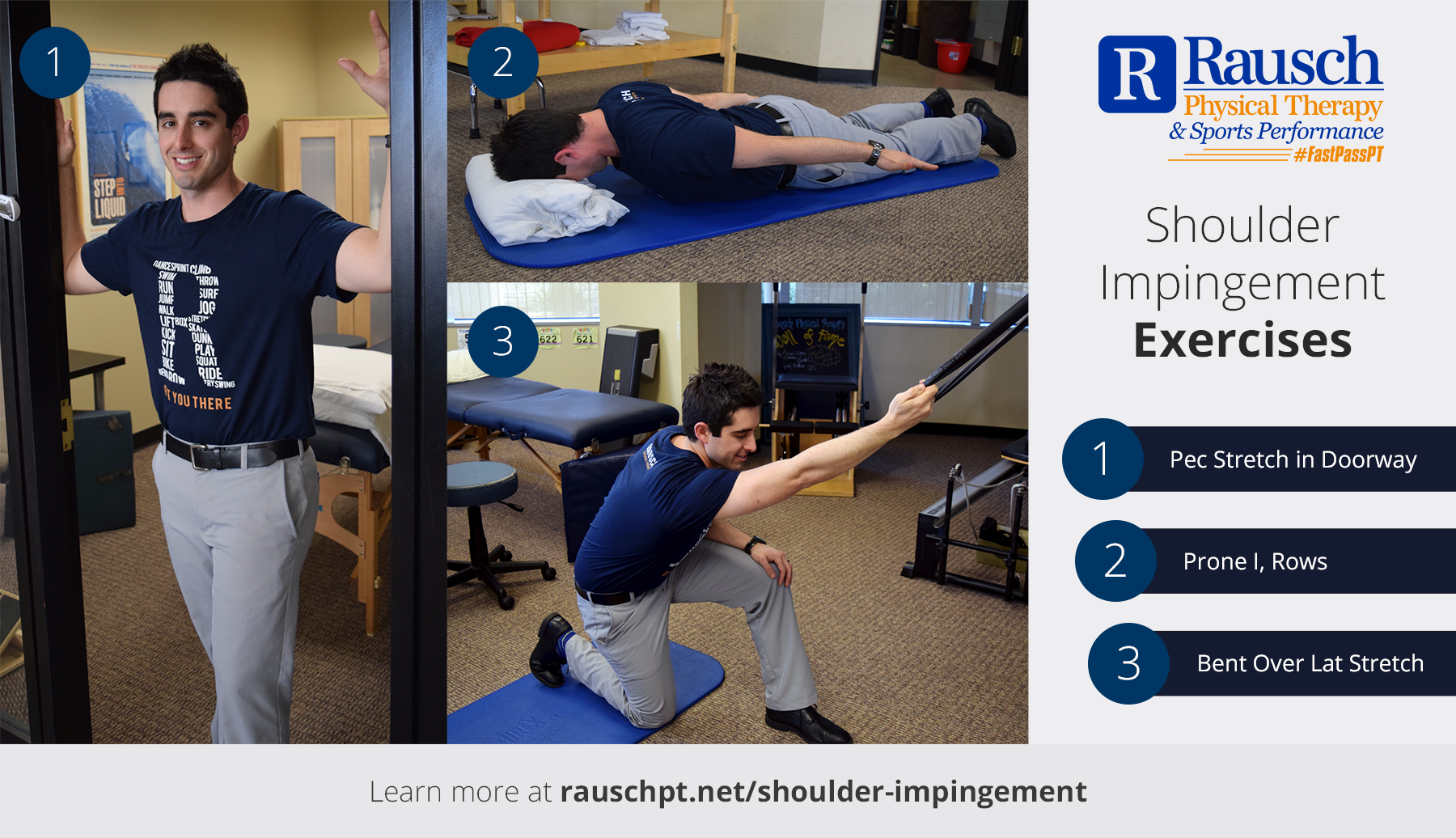
Here are three exercises to help alleviate shoulder impingement and encourage the recruitment of our shoulder blade muscles to improve posture:

2Jon-ShoulderImpingement-ExercisesClick to enlarge image

  1. Pec Stretch in Doorway: Lean forward in a doorway until stretch is felt (30 seconds x 3)
  2. Prone I, Rows: Laying on a flat surface, squeeze your shoulders blades together, then slightly lift your arms (15 reps x 2)
  3. Bent Over Lat Stretch: Grab band, turn palm up, kneel on opposite knee, then carefully lean back to feel stretch (30 seconds x 3)


In addition to these recommended stretches, you should also make modifications to certain activities that aggravate your shoulder, such as limiting overhead lifting and correcting your sitting posture throughout the day. If the painful arch continues, call us to make an appointment (no, you don’t need a doctor’s referral or Rx!) Our licensed physical therapists at Rausch Physical Therapy will quickly evaluate your specific injury and help alleviate pain and recommend additional exercises to help you finally find relief from chronic shoulder pain.


StaffHeadshot-JonJonathan Meltzer graduated from the University of Redlands with a bachelor of arts in biology and a minor in physical education. Following graduation, Jonathan discovered his passion for physical therapy while working as a Physical Therapy Aide. After graduating top of his class from Loma Linda University in 2012 with a Doctorate in Physical Therapy, Jonathan began his career at Rausch Physical Therapy and Sports Performance. Jonathan’s goals are to identify limitations and treat his patients with the most recent and innovative techniques in order to maximize functional independence and obtain his patients’ individual goals.


7 Ways to Avoid Injuries When Starting a New Exercise Program

LF-BLOG
BY LYNDSAY DEFILIPPO, DPT, RAUSCH PHYSICAL THERAPY

We have officially reached February! Are you still keeping up with that New Year’s Resolution to get back to the gym and get in shape in 2016? Hopefully you’re all answering with a resounding, “YES,” because healthy is where it’s at! For those of you who may have already broken your resolution, that’s okay, too! We still have quite a bit of 2016 left. Whether you’re looking to exercise more to get the body you want or to get back to your glory days of sporting, there are a few important notes to remember when kick starting a new workout regimen.

The beginning of the year is always a busy time for physical therapy clinics, not only because everyone starts fresh with their insurance, but also because so many people have a fierce new motivator (in the form of New Year Resolutions.) You probably notice how much more packed your gym, sports club, or Pilates class is with hopeful people looking to shed those extra holiday pounds, and with greater numbers of people exercising comes more injuries, and more patients for us! While we love our patients, we’d rather see you on the table for “pre-hab” not rehab, so here are a few tips for avoiding any New Year Resolution injuries.

7 Tips When Starting a New Exercise Regimen


1. Start slow, and don’t expect to begin where you left off.

Often we find that patients overdo it in the first few weeks of their program causing increased injury to the tissues. Some people write it off as “out of shape” pain, when in fact it could be a greater underlying issue. While it’s tempting to hit the ground sprinting on Day 1, don’t burn out your body or motivation! Take it slow that first month and allow your body to get used to working out again.

2. Have your form assessed by a professional.

Form evaluation is necessary for everything from running, lifting, swimming, throwing, etc. If you don’t have the necessary mobility, flexibility or stability, you can damage your body from the repetitive motions that cause stress on your joints, muscles and tendons. Having a professional evaluation by a sports performance expert will pay off in the long run by not only keeping you injury-free, but also by helping to improve your performance. We’re lucky to have running, biking and throwing analyses here at Rausch PT, but we can also assist with form in other areas as well.

3. Don’t compete with other people.

Your workout plan should cater to your body and your current abilities. A competitive drive is deep-seated in most of us, but when it comes to an advanced yoga pose and you are in your first ever class, swallow your pride and sit that one out. Start from the basics, ask for help and modifications, and I promise your body will thank you later.

4. Know your limits.

It’s okay to push your body to reach new levels, but you should always proceed within reason. Don’t ignore the signs where your body may be telling you to slow down, such as fatigue, excessive thirst, loss of motivation, long duration aches, pains, cramping, and even sleep disturbances and immune system crashes. There are also more serious side effects of overtraining which may require immediate medical assistance. You can read more about overtraining symptoms here.

5. Allow your body to recover.

This includes rest days, stretching and foam rolling before and after every workout, doing a nice dynamic warmup prior to exercise, staying hydrated, getting a good night’s sleep, and scheduling a therapeutic massage at least once a month. Your muscles and body are working hard for you, show them a little TLC!

6. Remember: Health starts in the kitchen.

I can’t stress enough how important it is to maintain a healthy diet that’s specific to your body. Avoid fad diets if you can and think long-term meal planning and healthy eating. Remember, you want this newfound routine of health to be for life! Also, don’t be afraid to seek help from a nutritionist who can craft a meal plan to match your lifestyle and your goals.

7. Switch it up and HAVE FUN!

If you find yourself getting bored with your exercise routine, change it up. If you’re a runner, try an upper-body-focused Pilates workout, or if you’re a swimmer, go for a bike ride. Cross-training will not only keep you entertained and your body guessing, it will also help you to avoid repetitive movements that can injure muscles.

If an injury should occur when getting back into an exercise routine, don’t wait for it to go away on its own or push through the pain. Make an appointment with your physical therapist; we here at Rausch Physical Therapy can quickly evaluate your injury and get you back on track toward your wellness goals.


StaffHeadshot-Lynds
Lyndsay DeFilippo PT, DPT, CKTP received her Doctorate of Physical Therapy from New York University in 2010. She’s a Graston Practitioner and a Certified Kinesiotaping Practitioner. Lyndsay looks at each injury as a constantly changing puzzle, which is only solved when her patient returns to what s/he loves doing. She enjoys helping with the full recovery process, which includes providing the education, tools and fundamentals to prevent re-injury and the potential for new injuries.