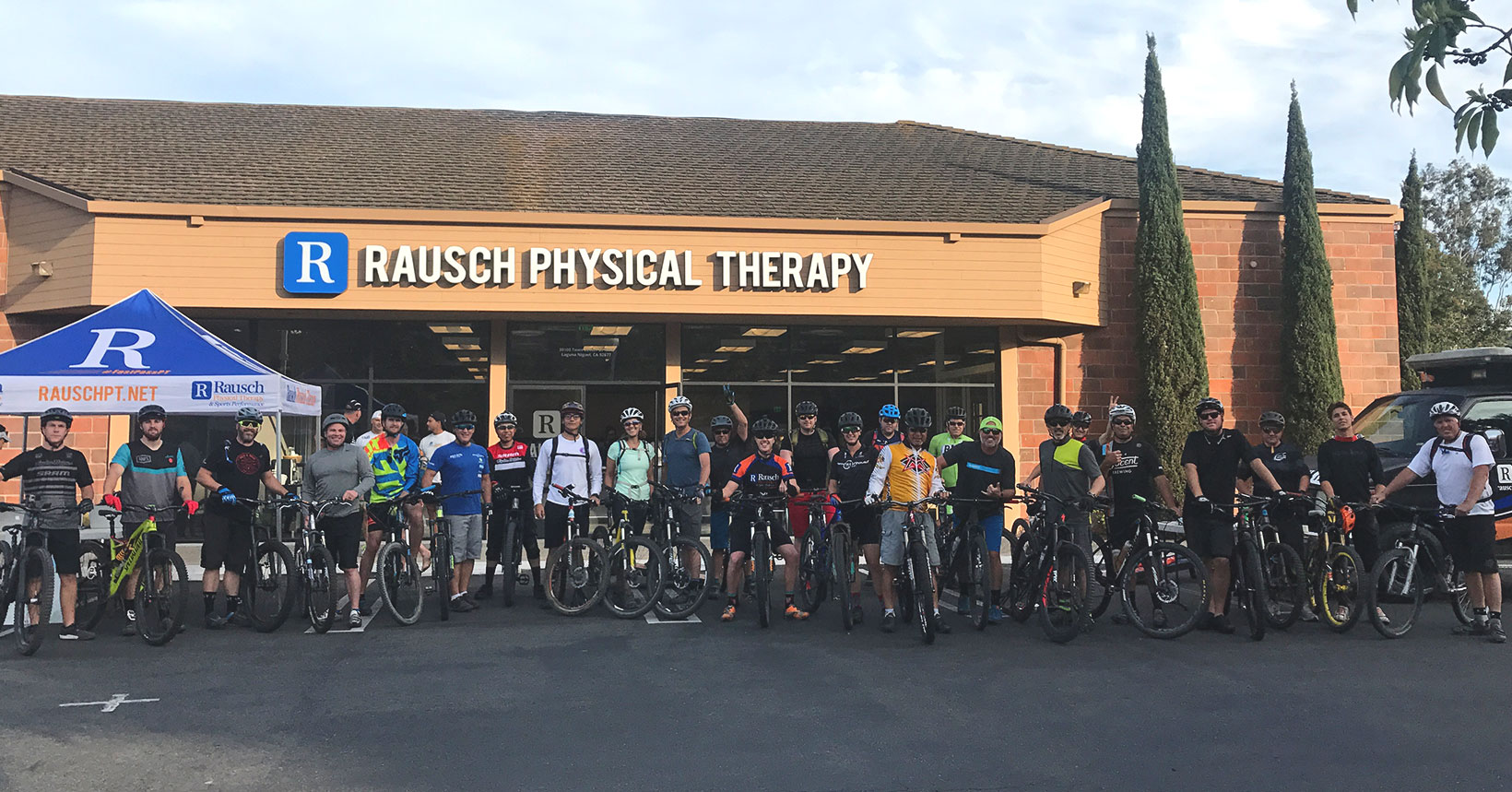
Join Rock N’ Road Cyclery and #TeamRauschPT for a fun, free social mountain bike ride for beginners and intermediate riders every 2nd Saturday of the month!
Meet here at Rausch PT (30100 Town Center Dr #Y/Z, Laguna Niguel, CA 92677) at 8 AM, ride leaves at 8:30 AM. Post-ride bagels & beverages + awesome giveaways & raffle prizes.
Let us know you’re riding with us!
Go to the Facebook Bikes & Bagels Event page and click “Going.” Be sure to share with your MTB friends while you’re there!
The Challenged Athletes Foundation (CAF) raises money to help people with physical challenges pursue an active lifestyle through physical fitness and athletics. CAF’s mission is clear: give those with the desire to live active, competitive lifestyles every opportunity to compete in the sports they love.
This year #TeamRauschPT will be participating in the CAF Thrive 5K Walk, and we want YOU to join our team. We’ll be fundraising at the clinic all October long, but if you’re interested in joining our team at the 5K on Sunday, October 21, please click the button below to go to our team page, then click the JOIN TEAM button. Can’t make it to the race? Show your support by making a donation now.
By making a donation towards our team fundraising goal you will provide individuals with physical challenges with the tools necessary to find success in sports—and in life!
When registering, Click the “Would you like to associate your participation with a Fundraising Group?” box and choose “Rausch PT” to help our fundraising goal!
[/one_half_last]
About CAF & San Diego Triathlon Challenge
Established in 1997, the Challenged Athletes Foundation (CAF) recognizes the athletic greatness inherent in all people with physical challenges and supports their athletic endeavors by providing unparalleled sports opportunities that lead to success in sports — and in life.
The Aspen Medical Products San Diego Triathlon Challenge is one of the most highly-regarded and motivational events in the triathlon world. Since its first event 20 years ago, the Tri Challenge has been instrumental in raising the funds that have allowed more than 9,500 challenged athletes around the world to make it to the starting line and inspired a new generation to realize they have no limits.
Everyone knows it’s more fun to run outside, the same thing goes for stretching! PT Ashley Heller shows how you can use picnic benches to help reduce running pain, avoid chronic injury, and improve recovery time while you’re out on a run.
BY ASHLEY HELLER, PT, MPT, RAUSCH PHYSICAL THERAPY
I’m an outdoor gal when it comes to working out. Although I am not competitive runner, running is my go-to outlet for keeping in shape and cross training. For me, running outdoors allows me to recharge, connect with nature, and is one of my favorite ways to cross train and maintain a healthy and active lifestyle.
Whether I’m exploring new trails or running the beach trail, I always make the time to do some dynamic stretches. Dynamic stretching before working out can help improve recovery by minimizing overstrain to tight muscles, as well as improve joint mobility to enhance proper muscle recruitment and minimize compensation that can lead to tissue breakdown and injury. Frequently, I will also stop about one mile into my run to help loosen up even more before finishing the end of my run. Incorporating a few stretches after warming up can be helpful for minimizing discomfort for the duration of the run, improving hip drive while running, and improving overall recovery time.
Since I am usually exercising outside, I love stretching on picnic tables. They offer a good surface for stretching with a variety of heights useful for multiple stretches, plus they are convenient since they are virtually everywhere!
Ashley’s Picnic Bench Stretch Series
Here are my five go-to stretches when I’m running outdoors:
#1 – Quad/Hip Flexor Stretch
Glutes are the driving power for running and propelling the body forward. Lack of hip extension results in decreased running efficiency. Tight hip flexors will limit the ability for the hip to extend and use the glutes. A good hip flexor/quad stretch will allow you to engage your glutes more efficiently.
Cue: Tilt the pelvis like you’re tucking your tail under. Gently squeeze your glute to help relax the psoas and gain a better stretch.
Common mistake: Leaning forward. This results in back extension, not hip extension, which is a common way runners injure their backs.
#2 – Hamstring Stretch
Hamstring tightness is often a contributing factor to back pain or hamstring strains. Hamstring tightness can pull the pelvis into a posterior rotation, which deactivates your abs while running and can lead to back pain over time. Adequate hamstring flexibility will also reduce the amount of tension placed on the sciatic nerve and reduce the risk of hamstring strains while running.
Cue: This can also be done as a long duration stretch for 30 seconds to 1-3 minutes.
Common mistake: Over rounding the back when leaning forward.
#3 – Calf Stretch/Prancing
This dynamic stretch is important for both ankle mobility and the elasticity of the calf complex. Calf flexibility is important in preventing calf strains while running. Stiff ankles result in poor shock attenuation can result in injury from the foot up to the back. Poor dorsiflexion mobility will shorten the calf and Achilles complex prematurely and can result in calf strain, Achilles Tendon or plantar fascia injury.
Cue: Start by standing on a curb or bench, hang the heels off and slowly lower the heel below neutral while bending the opposite knee to raise heel. Alternate dropping the heels to ‘prance’ to improve ankle mobility and calf flexibility.
Common mistake: Excessive pronation or flattening of the foot arch.
#4 – Standing Pigeon Stretch
The standing pigeon stretch opens the hip capsule and hip rotators. This will help promote glute activation and hip drive running.
Cue: Begin with one leg crossed over opposite leg. The thigh should be perpendicular to the body while the knee is bent at 90 degrees. Holding onto the table, lean back into a partial squat position while maintaining a flat back. This stretch can also be performed lying supine on picnic table by cross leg over opposite knee, hold thigh behind the non-stretching knee and pull towards chest.
This stretch can also be performed lying supine on picnic table by cross leg over opposite knee, hold thigh behind the non-stretching knee and pull towards chest.
Common mistake: Pain in knee. If there is discomfort in the knee, modify by performing stretch on your back.
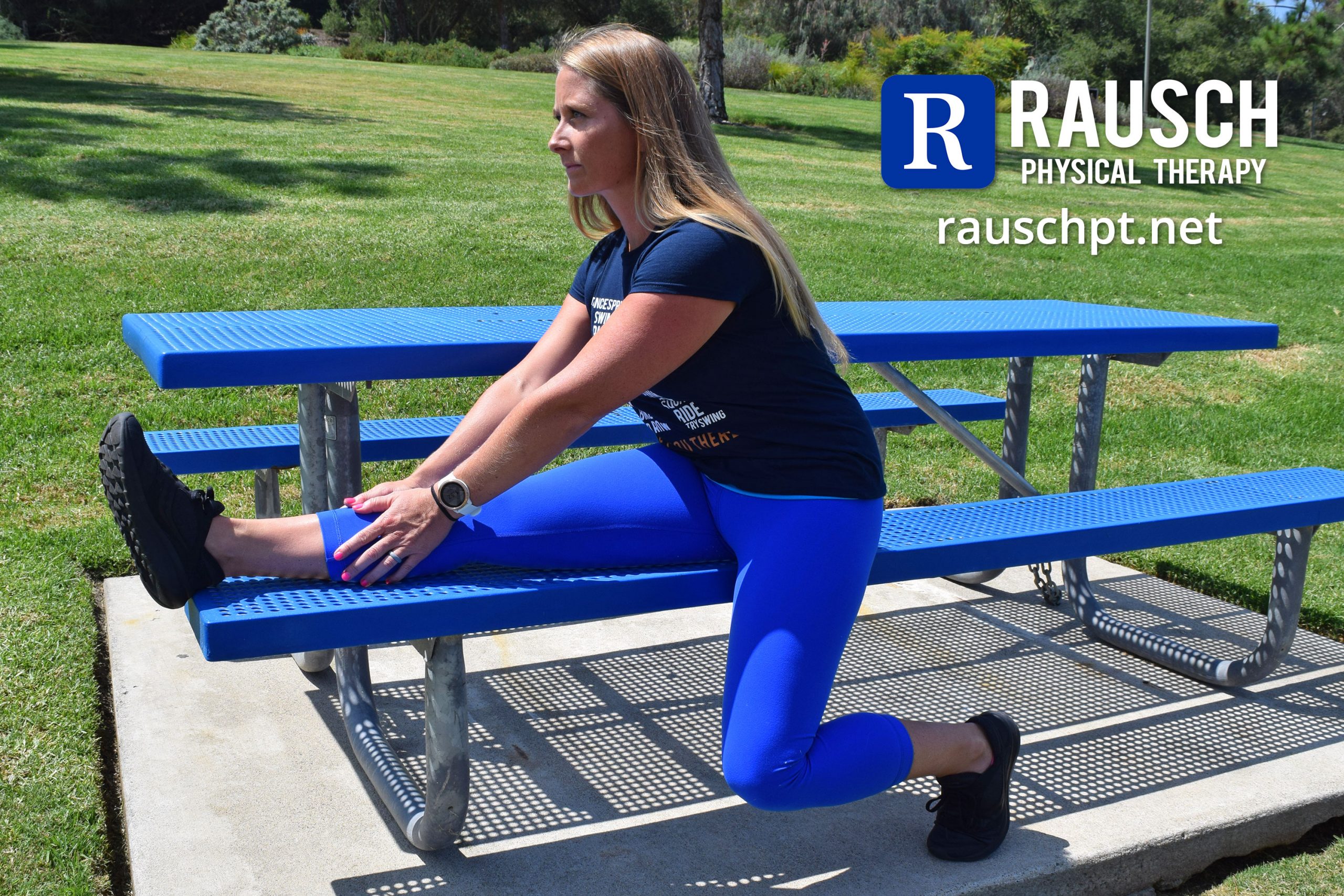
#5 – Adductor Side Lunge
This stretch targets the adductors, which are important for medial knee stability. Adductors can be overlooked when stretching but are important to stabilize the knee to prevent injury.
Cue: Using the table, place your foot of the stretching leg on the bench. Lunge away by bending the knee to about 90 degrees, keep your knee stacked over your ankle.
This can also be done as a dynamic stretch without the picnic bench by alternating lateral lunges. Alternate to stretch each side 5 times, hold 2-3 seconds before alternating.
Common mistake: Going too deep. Knee not stacked over ankle.
Ashley Heller, MPT is a licensed physical therapist at Rausch Physical Therapy & Sports Performance. She received her Masters of Physical Therapy degree at California State University, Long Beach and is passionate about working with patients with shoulder, knee and ankle injuries. With background in orthopedic-related injuries and post-operative rehabilitation, Ashley believes that the combination of manual therapy and personalized therapeutic exercise program is vital to recovery. Known as the Water Sports PT, Ashley says her goal is to help her patients better understand their injuries and the plan for their road to recovery.
Do you wake up with a stiff or aching neck every morning? Your pillow could be the culprit! PT Amanda Hurst breaks down pillow position 101 and shares her fluffy recommendations so you can get your best sleep and better morning.
BY AMANDA HURST, PT, DPT, ATC, RAUSCH PHYSICAL THERAPY
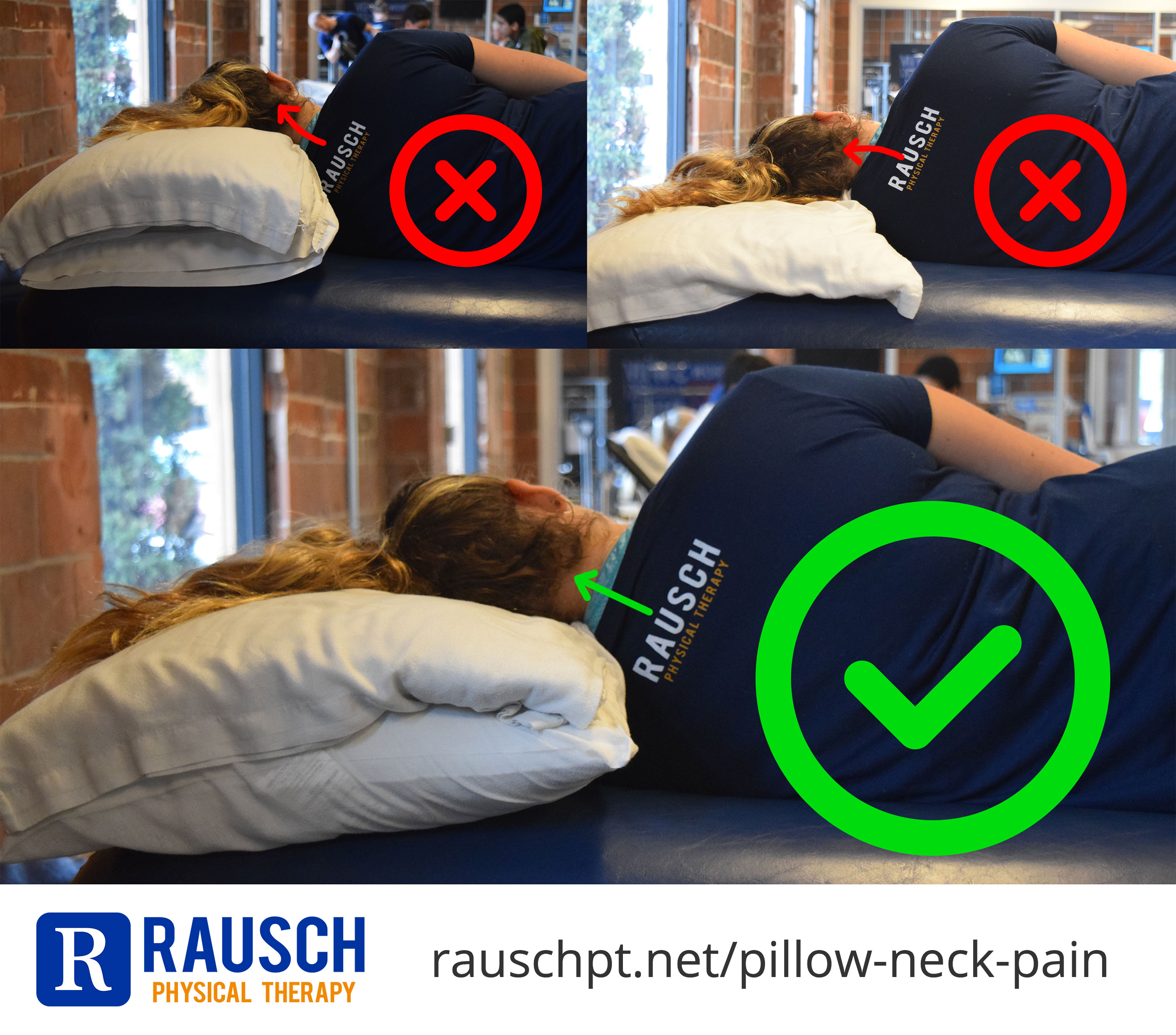
Do you wake up with a stiffness, pain or discomfort in your neck? It could be due to the position of your pillow. That’s right, your pillow is your friend and deserves to be used correctly! The purpose of a pillow is to support the weight of your head, which on average weighs about 11 lbs.
When your head is properly supported by your pillow, your neck muscles are allowed to relax or turn off, which means no muscle tension or pain in the morning. Here’s a simple four-step pillow check to help you rest easy:
If your shoulders are ON the pillow, your head will be NOT be supported! This creates increased neck extension shortening or tightening of the neck muscles, nerve impingement, and stiffness in the vertebral joints.
Tuck your pillow into the crevice of your neck and fully relax into it.
Your head should be in a neutral position, not too extended or too flexed forward (have someone check or take a picture for you.)
If your pillow does not allow your head to be in neutral, either go buy a new one or fluff that sucker up!
If you like your pillow and it doesn’t cause pain once you make sure you’re using it correctly, then keep it! If you make the adjustments above and you’re still waking up with stiffness, nerve symptoms or pain, it’s time to try a new pillow.
Down or alternative-down is recommended
Avoid foam pillows; they have a natural resistance that can cause your neck muscles to activate to combat that resistance while you’re sleeping
No, you do not need to spend your life savings on the newest, fanciest pillow. There are some great, affordable options that won’t break the bank and will still help you achieve that neutral position you need for a great night’s sleep and pain-free morning.
Amazon also has a large variety of synthetic down or goose down pillows, keep the price low and check the return policy in case the pillow does not work for you
Amanda Hurst, PT, DPT, ATC graduated from Concordia with her degree in Exercise and Sports Science and became a certified athletic trainer in 2010. She went on to receive her doctorate in physical therapy in 2013 from Chapman University and has been practicing as a licensed physical therapist for the past five years in a variety of physical therapy settings, including hospital and private practice outpatient, acute care, and lab assisting. Her love of sports led her to Rausch Physical Therapy & Sports Performance, where her goal is to return all her patients back to their sport, recreational activity or hobby, and to keep our community active, healthy and happy.
As a life-long outdoor enthusiast and doctor of physical therapy, PT Sean Swopes knows how dangerous and difficult high-altitude hiking can be for many people. Sean shares the unique way he prepared his body to battle the elements (and dreaded altitude sickness) while crossing off an item from his bucket list: summiting Mount Whitney.
BY SEAN SWOPES, PT, DPT, CSCS, RAUSCH PHYSICAL THERAPY
On July 16, I sought out to make a journey into the wild with my brother and father. The plan was to spend five days and four nights hiking our way north through the Eastern Sierras. Our experience would peak at the summit of Mount Whitney, reaching an ultimate elevation of 14,508 feet.
Anyone who’s done any amount of physical activity, whether it be hiking or cycling, will tell you that being at altitude changes everything. I’ve seen some of the most aerobically fit people fall apart once they’re at altitude. Having taken many trips to the Sierras throughout my life, I’ve learned this fact the hard way.
The months leading up to the hike, my main concerns were the distance and elevation. My main training modality was casual and competitive mountain biking, and while it did give me a big push for my cardiovascular training, I knew that alone wouldn’t prepare me for the 50+ miles I’d be walking with 50 pounds strapped to my back at 10,000+ feet.
Training Your Body to Adapt to Stress
Fortunately, during this trip, I felt great with no major signs of altitude sickness. I attribute this to not only mountain biking, but competitive mountain biking. The key difference is the extreme of how competition pushes the body to its limits. I hadn’t done any extensive altitude training within the weeks leading up to the trip, however I had taken my body—physically and aerobically—to it limits by racing at the Over the Hump series nearly every week this summer. That’s exactly what I was going to be putting my body through summiting three, 14,000+ feet mountains: Mount Langley, Mount Muir and Mount Whitney.
As a physical therapist, I like this concept of pushing your body to its limits as a training philosophy. I view the body as an instrument with a threshold of tolerance. As people age, their body tends to develop imbalances, weakness and stiffness, which decreases their body’s threshold for biomechanical stress (i.e. running, jumping, climbing, etc.) Consistent competitive racing forced my body to adapt and increased my body’s threshold, which enabled it to withstand more physical and aerobical stressors on my hike.
Still, there was one large unknown variable to conquer: altitude.
At high elevation, less oxygen can be inhaled per breath, which can cause hikers to experience early onset fatigue, or worse, altitude sickness. For most people, this takes effect when they get above 12,000 feet. To ensure my success at altitude, I got to the mountains three days early and went on two training hikes at 9,000-11,000 feet and slept at 8,000 feet; this allowed my body to acclimate.
The Challenge of Summiting Mount Whitney
If you look at Mount Whitney from the city of Lone Pine, just below the mountain range you’ll see two small peaks with a large peak just to the right. At the base of the two smaller peaks you are roughly at an elevation of 13,500 feet with 1,000 feet of elevation to gain over a distance of two miles. This is where most people feel the extreme effects of altitude, including my brother. He was hit with nausea, fatigue and a pounding headache, forcing him to turn around and head back to base camp.
With even more determination now, my father and I continued our ascent. It wasn’t until the last half-mile that he was met with his final challenge. The altitude was taking its effect on him, but luckily he wasn’t experiencing any other symptoms other than extreme fatigue. His body would feel fine at rest, however any physical exertion would drain his energy instantly. It was slow-going that last half-mile while he was forced to take breaks every 10 feet of hiking the variable rocky terrain, but in the end we both prevailed, reaching the summit and our goal destination at 14,508 feet.
The toughest endeavors always make the most memorable experiences. Think of your body as an instrument you are constantly fine tuning. Preparing for those tough, yet memorable life adventures to the top of any “mountain” in your life.
Nothing in the world is worth having or worth doing unless it means effort, pain, difficulty… I have never in my life envied a human being who led an easy life. I have envied a great many people who led difficult lives and led them well.
― Theodore Roosevelt
Sean Swopes, PT, DPT, CSCS graduated from CSU Fullerton with a bachelor of science in kinesiology. He went on to receive his doctorate in physical therapy in 2015 from University of St. Augustine, and began his career here at Rausch Physical Therapy and Sports Performance. Sean is also a certified Strength and Conditioning Specialist. As a physical therapist, Sean’s goal is to help his patients understand their musculoskeletal impairments and work together to improve them.
If we have no problem spending the time or money to take our cars in for a tune-up on a regular basis, why do so many people struggle doing the same for their body? PT Ruth Meltzer explains why putting your body on a maintenance program will benefit you in the long run.
BY RUTH MELTZER, PT, DPT, OCS, RAUSCH PHYSICAL THERAPY
Do you own a car? Do you take it in for regular tune-ups? Even if there aren’t any glaring issues, I bet you do take your vehicle in to the shop every x-amount of miles to get the tires aligned, change the oil, and have an expert take a peek under the hood to ensure everything is running how it should be.
We all know that proper maintenance helps avoid costly breakdowns, long-term mechanical problems, or *gasp* having to go days without a car while it’s getting fixed. So if we have no problem spending the time or money to care for our cars on a regular basis, why do so many people struggle doing it for their body? Do you really value a car more than your health!?
We need to change the way we think about our health and wellness and finally take charge of our bodies. “Wellness” is defined as “the quality or state of being healthy in body and mind, especially as the result of deliberate effort.” We need to deliberately make the choice to get healthy and stay that way. By being your own advocate and putting your body on a maintenance program—just like you do with your car—you can keep your (musculoskeletal) parts oiled, aligned and moving correctly to avoid costly breakdowns (injuries).
Direct Access and #FastPassPT
Let’s say you’ve signed up for a triathlon, but during your second week of training you notice your shoulder bothers you after every swim. However, you’re determined to keep training, so you ignore it for weeks until the pain has become so bad that you finally decide to go see your doctor. You wait weeks to get in to see her, just to have her tell you to schedule a physical therapy appointment. By this time, months of neglect have turned a minor issue into a major injury that will now take more time, money and energy to address.
This is just like an easily avoidable car breakdown. Your check-engine light comes on (first twinge of pain), but you ignore it because of time or money or just plain negligence. You keep trucking along, until that fateful day when you break down on the side of the road (injury). Now you have to wait hours (weeks) for a tow truck (doctor’s appointment) and pay for that. Then you have to pay the mechanic to figure out the problem and fix it (PT)! Your car (body) is out of commission for weeks, and you’re stuck Ubering around (putting your training on hold) thinking how all this could have been easily avoided with better care and maintenance.
It doesn’t have to happen like this! If you live in California or any other state with Direct Access laws, now is the time to take charge of your health and come in to physical therapy for regular tune ups before you get injured or at the first inkling of pain, no doctor prescription necessary.
What Does a Wellness “Tune-Up” Look Like?
At Rausch Physical Therapy, we call tune-ups “Wellness Checkups,” and we recommend one every six months. At your checkup, a doctor of physical therapy will do a quick assessment of your body’s flexibility, strength, control, and movement to identify and address any dysfunctions. You leave with an individualized plan of care and strength and stability exercises to do at home to help prevent any potential issues down the road.
As musculoskeletal experts, physical therapists treat the body as a whole; when you come in with knee pain, we know to look at your hip, pelvis, spine and foot to see how they might be affecting your knee joint. Getting regular tune-ups with your physical therapist will help keep your alignment in check to guarantee all your parts are working like they should be. Of course, if injury does happen, you can come DIRECTLY in to see your PT as soon as you feel it. The longer you wait, the more time your muscles have to create imbalances and cause long term dysfunctions.
I hope this summer you decide to start keeping up the maintenance on your body like you keep up your car. With proper care and upkeep, you can ensure your body is always able to continue doing what you love to do and ready to handle anything life throws your way. Come see me at Rausch PT, and I’ll help you get started on a successful wellness program!
Ruth Meltzer, PT, DPT, OCS is a licensed physical therapist at Rausch Physical Therapy & Sports Performance. She received her Doctorate of Physical Therapy degree at Loma Linda University in 2012 and received her orthopedic specialization in 2015. Ruth enjoys looking at functional movements and tailoring exercises and programs to help her patients as an individual not just a body part.
Baseball season is tough enough on a young athlete’s body, should you really be throwing in the offseason? PT Jonathan Meltzer explains what you should do in the offseason to set yourself up for a successful, healthy upcoming season.
BY JONATHAN MELTZER, PT, DPT, RAUSCH PHYSICAL THERAPY
Baseball demands a lot out of a young athlete’s body through the course of a season. It’s the only sport that plays on consecutive days in a week, multiple weeks throughout the year. The ability to make it through the season healthy takes time, effort and diligence. As The Baseball PT, the questions I always ask my patients at the end of the season are:
Did you stretch, foam roll and warm up properly before and after every practice and game?
Did you let your coach, trainer or physical therapist (me) know if you were struggling with pain or an injury?
The answer should be a resounding, “Yes!” to all these questions. If your answer is, “I’ll just deal with it/recover in the offseason,” guess what? It’s the offseason and your arm is sore, your legs and back feel tight, but then club/college teams are asking you to jump on their team! Should you do it? Is it smart? Are you risking your arm health?
The fact is that playing summer ball or going to college recruitment is a top priority if you want to advance your baseball career, and I agree that you should take advantage of those opportunities. However, I have specific recommendations for my players, especially pitchers, to help them be smart about offseason play.
#1 – Take a four to six-week break
Immediately after the season ends, I recommend you take four to six weeks off from throwing completely. The shoulder and elbow need about a month for the tissue to calm down, regenerate and recover from the season-long wear and tear. Consider this time as an “active rest,” defined by:
Cross Training with a different sport or activity
Recovery with soft tissue work and stretching
Once you have completed the recommended four-to-six week break, begin a return-to-throwing program—slow and steady.
#2 – Get strong in the summer
Summer is the time to lift and get really strong so you can improve the dynamic stability and rotational strength you need to return to play. Implementing specific strength exercises, such as lunges, deadlifts, and rotational med ball toss, as well as agility training and plyometric exercises, are crucial during this time.
Conclusion
So, to throw or not to throw? Both! Take that initial four to six weeks off to let the tissue heal, then progress into an interval throwing program. If you’re confused on how to do this, make an appointment with me at Rausch Physical Therapy & Sports Performance; I’ve developed a return-to-throwing program that will get you where you need to go. If you use the offseason to develop good recovery habits, train hard and expand your strength, you can set yourself up for a successful upcoming season.
Jonathan Meltzer graduated from the University of Redlands with a bachelor of arts in biology and a minor in physical education. Following graduation, Jonathan discovered his passion for physical therapy while working as a Physical Therapy Aide. After graduating top of his class from Loma Linda University in 2012 with a Doctorate in Physical Therapy, Jonathan began his career at Rausch Physical Therapy and Sports Performance. Jonathan’s goals are to identify limitations and treat his patients with the most recent and innovative techniques in order to maximize functional independence and obtain his patients’ individual goals.
PT Kevin Capata shares why its not the lack of mileage that you put into your training schedule that has kept you from reaching your PRs, staying injury-free, or conquering plateauing, but the often forgotten aspect of cross training.
BY KEVIN CAPATA, PT, DPT, CSCS, RAUSCH PHYSICAL THERAPY
If you’re an amateur triathlete like me, you’re probably often stressed trying to juggle all the tasks of daily life with a set training plan, strict dietary guidelines, and recovery efforts. So maybe you’ve already heard about the benefits of adding cross training to your plan, but you’ve always thought, “I just don’t have time. When am I supposed to get to the gym to lift weights or attend weekly Yoga class?” “How the heck am I supposed to cram in even more training?”
All good questions, and trust me, I get it! But I challenge you with one of my own. Have a 25-mile ride planned for Monday morning? Why not make it 22 miles, and use that extra 15 to 20 minutes to do some single-leg pistol squats, burpees, plank bird dogs, and pull ups?
It’s not the lack of mileage that you put into your training schedule that has kept you from reaching your PRs, staying injury-free, or conquering plateauing. More likely than not, it’s that you haven’t unlocked your true athletic potential by adding strength and mobility to your priority list.
The Forgotten Fourth and Fifth Disciplines of Triathlon: Strength and Mobility
Many triathletes fail to realize that by developing strength, power and mobility through cross training, they can enhance their ability to maintain that high-elbow position throughout their swim stroke, keep that high-power output during the last climb before heading into T2, or prevent the dreaded “bonk” associated with form breakdown midway through the run.
Yes, specificity of training is of utmost importance and you have to get in that swim, bike and run mileage to work toward your goals. However, to perform your best—and STAY performing your best—you also have to dedicate time to keeping your body in optimal shape.
To help, here are my top strengthening and mobility exercises. Try incorporating this exercise routine into your training plan, and I think you’ll see a dramatic difference in your performance that will finally shift your mindset on the importance of cross training once and for all.
Kevin Capata,PT, DPT, CSCS is a licensed physical therapist at Rausch Physical Therapy & Sports Performance. After receiving his Doctor of Physical Therapy degree at Columbia University, Kevin started his career at Rausch PT, where he used to work as a physical therapy aide. Now, Kevin enjoys helping his patients recognize and fix movement faults to help them overcome their injury or pain, as well as empowering them with the knowledge and tools to prevent re-injury or potential new injuries.
The only things cyclists should have to worry about wearing out are their tires—not their joints! Mountain Bike PT Sean shares how to stabilize three key areas of the body to prevent most cycling-related injuries.
BY SEAN SWOPES, PT, DPT, CSCS, RAUSCH PHYSICAL THERAPY
There are certain rules-of-thumb when it comes to the human body and how we are designed to move; our bodies are designed to walk, stand, sit, sleep and eat. Not on that list? Ride a bicycle.
However, that doesn’t stop us humans from having a lot of fun riding them! In fact, with research, experience and continued learning, we can make body and bike work well together. One way is to get a bike fit, which sets up the bike’s geometry to best fit the rider. You can also find a program like Ride Right, which focuses on the rider’s biomechanics. However, the most important (and oft forgotten) step if you’re planning to get into any type of cycling is first getting your body ready to tolerate all the stress it will endure while pedaling, climbing and descending.
As the Mountain Bike PT, I work with a lot of cyclists who deal with chronic pain or injury without realizing that they need to get their body in the correct balance. Like I said, the human body was not designed to be on a bike, but if you focus on and prepare a few key musculoskeletal areas, you can ride for miles without the unwanted stress.
The most commonly injured areas on a cyclist’s body are the knees, back and hips. If you can get your body in an optimal balance of strength and flexibility (also known as stability) in these areas, you can prevent most injuries on the bike.
Sean’s “Bike Bod” Exercise Program
Here are five exercises to help you gain the crucial knee, back and hip stability you need to avoid most cycling-related injuries before you even hop on the bike:
Thoracic extension over a foam roll. The goal of this stretch is to improve the mobility of the thoracic spine to improve the postural alignment of the spine and decrease unnecessary stress to the lumbar spine.
Prayer Stretch (Child’s Pose.) This a truly versatile stretch that can improve your overall mobility. The key is to prevent your lumbar spine from becoming overly-flexed to emphasize maximal mobility out of the hips.
Hand Up Stretch (Couch Stretch.) The focus of this stretch is to improve your quadriceps and hip flexor mobility. The key is to maintain a posterior pelvic tilt (flatten the curvature of your lumbar spine) while sitting up tall.
Squat with a stick overhead. This is not only a great exercise, it’s also an assessment. It will point out the flexibility and lumbopelvic (core) weakness you have.
Dynamic LE warm up: Worlds Greatest Stretch (WGS) and Inchworms. WGS will take every aspect of the body to its end-range to prepare it for what’s to come, while inchworms focus on improving mobility of the entire posterior chain.
*Check back soon for my video explaining more about these five exercises!
Conclusion
As an avid cyclist, the only things you should have to worry about wearing out are your tires—not your joints. By taking the time and doing the work to optimize your body stability, you can defy human nature and adapt your body to your bike so you can continue to enjoy riding for many years, pain-free.
Sean Swopes, PT, DPT, CSCS graduated from CSU Fullerton with a bachelor of science in kinesiology. He went on to receive his doctorate in physical therapy in 2015 from University of St. Augustine, and began his career here at Rausch Physical Therapy and Sports Performance. Sean is also a certified Strength and Conditioning Specialist. As a physical therapist, Sean’s goal is to help his patients understand their musculoskeletal impairments and work together to improve them.
One of the more common—and arguably one of the most devastating—injuries a young athlete can sustain is an ACL tear. Diana Wang, PT, DPT, ATC explains what causes ACL injuries and why she believes it’s so crucial for young women to be proactive to prevent this scary setback.
BY DIANA WANG, PT, DPT, ATC, RAUSCH PHYSICAL THERAPY
One of the most common (and arguably one of the most devastating) injuries a young athlete could sustain is an ACL tear. Your ACL, or anterior cruciate ligament, is a part of a team of ligaments in the knee that helps maintain stability and withstand the force/stress from daily movement and physical activity. The main job of the ACL is to limit forward motion of the tibia (the lower leg) on the femur (the upper leg.) The ACL also limits tibial rotation when paired with an angular force at the knee.
What Causes the ACL to Tear?
The ACL limits certain motions, but just like any other soft-tissue structure in the body, there is a limit to its limitations.
While parents often fear their young athlete will get injured from being aggressively slammed in to, the fact is that 70-78% of ACL tears are non-contact, meaning there was no involvement of external forces. The most common mechanisms of ACL tears include:
The “plant-and-twist” motion
Sudden deceleration
Hyperextension of the knee
With that said, athletes in sports that involve repetitive jumping, landing or cutting—such as basketball, soccer and volleyball—are at a higher risk for ACL injuries. And what puts young athletes at even more risk? Being female.
Why Female Athletes are More Vulnerable to ACL Tears than Male Athletes
According to the National Institutes of Health, female athletes are two to eight times more likely to suffer an ACL injury than their male counterparts. Here are three reasons why:
#1: Anatomical differences
Females are born with wider hips than males; because of this, the alignment between the hips and the knee (known as the “Q-angle”) increases and makes females more susceptible to a “knocked knees” posture. This abnormal posture forces more torsion in the internal rotation and adduction angles in an attempt to create more knee stability. This then increases stress on the ACL, thus increasing risk of injury.
#2: Muscle imbalances
In general, most people have a poor quadriceps-to-hamstring ratio. However, females tend to be more quadriceps dominant during functional activity compared to males, especially during deceleration or sudden changes in direction. This quadriceps dominance produces repetitive anterior shear forces of the tibia on the femur, which then increases stress on the ACL to do its job and limit these forces. As I mentioned earlier, there is a limit to its limitations, so if the forces overpower the strength of the ACL, something’s gotta give.
#3: Hormonal changes
During menstrual cycles or hormonal changes (Hello, puberty!), soft-tissue structures tend to loosen up, which decreases overall joint stability and therefore increases risk of injury during that time. Unfortunately this factor is the most uncontrollable, but the prescription of a specific and well-developed exercise program will prepare any young athlete to withstand the stresses of physical activity, regardless of what their body is going through.
How to Decrease the Risk of ACL Injury
Preventative rehabilitation is key to reducing risk of ACL injuries! While you can’t change anatomy, you can train your body to combat instability and the stressors that comes with physical activity. The first step for prevention is to visit a physical therapy clinic and undergo a functional movement screen with a licensed physical therapist. From there, your physical therapist will create an individualized and specialized exercise program focused on mobility and stability tailored to your needs.
Disclaimer: No movement screen will guarantee prevention of injuries. However, they are extremely useful for physical therapists to identify movement faults that may increase risk of injury.
Diana Wang graduated from the University of the Pacific with a bachelor’s degree in Athletic Training. Following graduation, she knew she wanted to pursue her love for sports rehab further and received her Doctor of Physical Therapy degree in 2017 and began her career at Rausch Physical Therapy & Sports Performance. With her extensive sports background, Diana’s goal is to provide the best, most innovative care to get athletes back in the game faster and stronger than ever.
HIIT, or High Intensity Interval Training, is a popular workout philosophy that promises big results in a short amount of time. However, it also puts its participants at a higher risk for injury. PT Jonathan Meltzer explains how taking a few precautionary steps will allow you to enjoy HIIT workouts safely and effectively.
BY JONATHAN MELTZER, DPT, RAUSCH PHYSICAL THERAPY
In recent years, bootcamps, training groups, and other fast-paced workout classes have become increasingly popular, especially in areas like Orange County where we’re all busy, active people (willing to spend on beauty, health and wellness.) Rather than hitting the gym solo, people have started HIIT—High Intensity Interval Training.
Instead of spending hours at the gym, people are flocking to small, local fitness studios or clubs that offer 30 to 60 minutes HIIT workouts, which is various exercises at short intervals. When you add in the bonus of having a coach or instructor leading you through every session, it’s easy to understand why these independent facilities are so popular amongst people looking to transition off the couch.
In fact, the theory of HIIT is brilliant; it gets the heart rate up, combines cardio and strength into one session, and provides variation to avoid workout boredom. For a society that craves immediate gratification, HIIT is great. I myself was a member of a club for more than two years, and it got me in the best shape of my life.
However, as a doctor of physical therapy, I know how to prepare and protect my body for HIIT workouts, and unfortunately I’ve seen too many patients on my table who don’t.
Understanding the Risks of HIIT Workouts
With the increase in popularity of CrossFit, boot camps, etc. came an increase in the number of HIIT-related injuries I saw pop up on my schedule. HIIT has an increased risk of injury compared to lower-intensity workouts, especially for people who have been living a underactive lifestyle prior to jumping into it.
As a shoulder injury specialist, I see patients with rotator cuff sprains, pinching impingement pain and full blown labral tears because their coach put them through 20 minutes of various shoulder exercises, or had them pressing dumbbells into the air over and over just jamming the joint. Others are suffering pain in their knees, lower back stiffness and pain or stiffness in their hips from doing squat/lunge/burpee-type exercises without having first developed proper hip stability to support their body through these intense workouts.
HIIT workouts focus on global stabilization, which means that bigger muscles (those “show me” muscles) get worked a tremendous amount, but too often it’s without proper local stabilization. Just think, it doesn’t make sense to have a nice big house on the beach if the foundation is made of sand—it’ll be washed away in the first storm. However, if you put in the effort and take the time to build up a strong, stable foundation, your beautiful beach house is going to be able to withstand a whole lot more—and look good doing it!
Prepare Your Body to Take the HIIT
While the risks associated with HIIT workout regimens are higher than low-intensity ones, for some people the results are worth it. Like I said earlier, I was in the best shape of my life when I was doing HIIT, but I remember I had the awareness and knowledge to ensure I was doing it safely. Now I make it a point to educate my HIIT-loving patients to keep them healthy and off my table.
Here are the four things I tell anyone who’s thinking about starting or currently doing HIIT workouts:
Get a screen by your physical therapist. Before starting any new exercise routine, you should first get checked by a musculoskeletal professional to ensure your body isn’t vulnerable in areas that are commonly injured during these types of workouts. Not only can your physical therapist identify any impairments of flexibility or strength, s/he can help you address it before diving into a new workout regimen and educate you on how to protect your body once you get going (which will keep you off their table in the long run!)
Listen to your body. Are areas in your body starting to become more sore, tender or not firing the way they should? Usually the body starts to feels slightly different as a warning sign that an injury is about to occur. Being in tune with what you feel in your body will go along way to prevention.
Avoid repetitive movements for the same body part. Performing similar types of exercises repeatedly will continue to wear out the body because you are creating the same movement patterns over and over. Make sure your workout is never hyper-focused on just one muscle group—opt for a total body workout!
Workout with an experienced, certified trainer who knows their stuff. I cannot stress this enough! If you are not evaluated or looked at before you start at a new fitness place, you are setting yourself up for failure. Your trainer or coach needs to be detailed, specific and have a keen eye to watch for over-recruitment and poor form at ALL times.
Conclusion
As a results-driven guy, I’m a big fan of high-intensity interval training, but as a physical therapist I also want people to understand the importance of protecting yourself with the necessary awareness and tools to avoid the alarmingly common traumatic and chronic injuries associated with this type of exercise. Luckily, by being aware of your body and taking a few precautionary steps, you can enjoy HIIT workouts safely and effectively and ultimately get in the best shape of your life.
Jonathan Meltzer graduated from the University of Redlands with a bachelor of arts in biology and a minor in physical education. Following graduation, Jonathan discovered his passion for physical therapy while working as a Physical Therapy Aide. After graduating top of his class from Loma Linda University in 2012 with a Doctorate in Physical Therapy, Jonathan began his career at Rausch Physical Therapy and Sports Performance. Jonathan’s goals are to identify limitations and treat his patients with the most recent and innovative techniques in order to maximize functional independence and obtain his patients’ individual goals.
Just because you’re going to age doesn’t mean you have to be okay with aches, pains and giving up the activities you love! PT Kevin Capata shares how you can stay active and keep doing what you love as you grow older.
BY KEVIN CAPATA, DPT, RAUSCH PHYSICAL THERAPY
Every time I hear, “Don’t ever get old! It’s terrible!” I can’t help but think, “That’s a mindset problem.” Granted, I’m only 28 years old, but I compete in IRONMAN events and I can guarantee that the 75-year-old finisher would agree with me.
The truth is we are all human beings, which means we are ALL going to age, get weaker, have more aches and pains, and just generally slow down. It is hard to accept, but once you do you set yourself up for success to keep doing what you love as you age.
I can’t count the number of times I have heard a patient say their doctor has told them to stop running or doing stair repeats at their favorite beach, but that it is exactly those things that keep them motivated through their day with a smile on their face. In these cases, I say, “Forget what the Doc said! Let’s figure out a way to manage whatever your limiting factor may be so you can keep at it!”
Whatever your age, here are three ways you can manage your aches, pains, dysfunctions or diagnoses better so you can maintain or improve your quality of life for years to come.
#1 – Develop a Movement Practice
To be able to continue enjoying your favorite activities, such as running, surfing, hiking, Yoga, etc., STOP DOING NOTHING when you are not participating in those activities!
It has become all too common to sit on our butts all day long, often behind some sort of screen. Most people sit in front of their computer at work for eight hours, then they go home and sit on their butt to eat dinner, only to then go sit on their butt to watch TV while scrolling mindlessly away on their phone (that’s TWO screens at the same time!) I have now addressed this problem in nearly every article I have written, and the solution comes down to the same two answers every time: effort and good habits.
Start to become aware of how often you maintain one position throughout the day, and change it as often as possible. There are so many easy ways you can do this, such as:
Setting an alarm every 10 minutes at work to get up or just change your position
Taking the cushions off your couch and putting them on the ground to remind you to lay on the floor and stretch or use your foam roller
Requesting a high-top table at your favorite restaurant so you’re not sitting in the exact same type of chair as you did at work all day
They seem so simple, but these small changes can have drastic long-term effects in the way you move and feel. Stay dedicated to your movement practice, and one day YOU can be that badass 80 year old you see every weekend charging up the local trails while smiling ear to ear.
#2 – Go to Sleep!
We all know how important it is for our health and well-being to get enough sleep on a regular basis—so why don’t people do it? It even seems to be a common theme amongst my patients (who are already in pain to begin with) to sacrifice sleep for almost anything and everything else.
It blows my mind that people can view the fact that they only get four to five hours of sleep per night as a sign that they are extra productive or working harder than everyone else. If this sounds like you, read 10 Reasons Why Good Sleep is Important, then try to still justify your lack of sleep as anything positive.
To start making some positive changes towards the quality of sleep you are getting, try these suggestions:
Stop using/looking at electronic devices at least 30 minutes before bed. Yes, it is possible! Instead, read a book, listen to relaxing music while you stretch or foam roll, or even try out that lost art form of talking to your loved ones.
No bright lights at least 30 minutes before bed.
Take the TV out of the bedroom! It does NOT belong in there (for more than one reason…)
Go to bed/wake up around the same time every night/morning. Our bodies adapt to a specific circadian rhythm—use this to your advantage!
Get at least seven hours each night… MINIMUM!
Just as developing a movement practice requires a change in mindset, so does making sure you get adequate sleep. It might be hard when you start off (especially that whole no-phone-before-bed thing) but future-you will thank you.
#3 – Reduce Your Daily Stressors
Let’s say you have had nagging neck pain ever since you strained it while playing a game of pickup basketball with your coworkers, but it has been two weeks, and it seems like it is finally starting to feel better. Then, all in one week, your boss drops three huge deadlines on you, you get a speeding ticket rushing to pick up the kids from school, and, oh yeah, your mother-in-law is in town staying at your house. All of a sudden, your neck pain has come roaring back with a vengeance! You have not done anything from a musculoskeletal perspective to cause an increase in dysfunction or strain, but nevertheless the pain is as worse than ever. Why?
It has been proven that excessive stress can have serious short and long-term effects on both your mental and physical health. Health magazine lists 25 Surprising Ways Stress Affects Your Health and states about 70% of doctor visits and 80% of serious illnesses may be exacerbated or linked to stress.
Just like all human beings age, all human beings stress. Stress can be beneficial, such as when it activates your “fight or flight” response say if for some reason you are getting chased down by a mountain lion on a trail run. However, daily psychological stress can hurt your health. Once again, it is your mindset that can really make a big difference in how you manage and reduce the impact of daily stressors on your life. One of my favorite quotes is by Marcus Aurelius, “You have power over your mind, not outside events. Realize this and you will find strength.”
Here are two quick ways you can rest your mindset to reduce stress on a daily basis:
Start some sort of mindfulness or meditation practice. This can be as easy as setting aside five minutes of your day to find a quiet environment, close your eyes, and take in some full and deep belly breaths.
STOP and check your stress. When feeling overwhelmed, anxious or worried about a task, STOP and ask yourself, “Will stressing about this help me get things done better, quicker, more efficiently or effectively?” If the answer is no, reset your mindset and make a plan to just get it done.
Following my advice above (develop a movement practice and get adequate sleep) will also help reduce stress, all of which will help you remain active and lively til the end!
Conclusion
By following these three simple guidelines, you can get on track towards developing the habits, tools, and mindset necessary to enjoy an active, fun, and healthy lifestyle at every age. Honestly, with the way our nation’s healthcare has been going these days, it is now more important than ever that you take full control of your own health and well-being to ensure you’re not just living, but living well.
If you need help getting started, come in to Rausch Physical Therapy and meet with me or one of our other physical therapists. We are one of the few people whose entire job is to be your wellness coordinator and keep you on track to not only help you get healthy, but stay healthy—for life!
Kevin Capata, PT, DPT, CSCS is a licensed physical therapist at Rausch Physical Therapy & Sports Performance. After receiving his Doctor of Physical Therapy degree at Columbia University, Kevin started his career at Rausch PT, where he used to work as a physical therapy aide. Now, Kevin enjoys helping his patients recognize and fix movement faults to help them overcome their injury or pain, as well as empowering them with the knowledge and tools to prevent re-injury or potential new injuries.
You do not need a doctor’s referral to schedule physical therapy with our team. If pain is getting in the way, we are here to help you move forward with personalized care built around your goals.
Get started today and take the first step toward moving with less discomfort, recovering with confidence, and getting back to the activities you love.






















 Diana Wang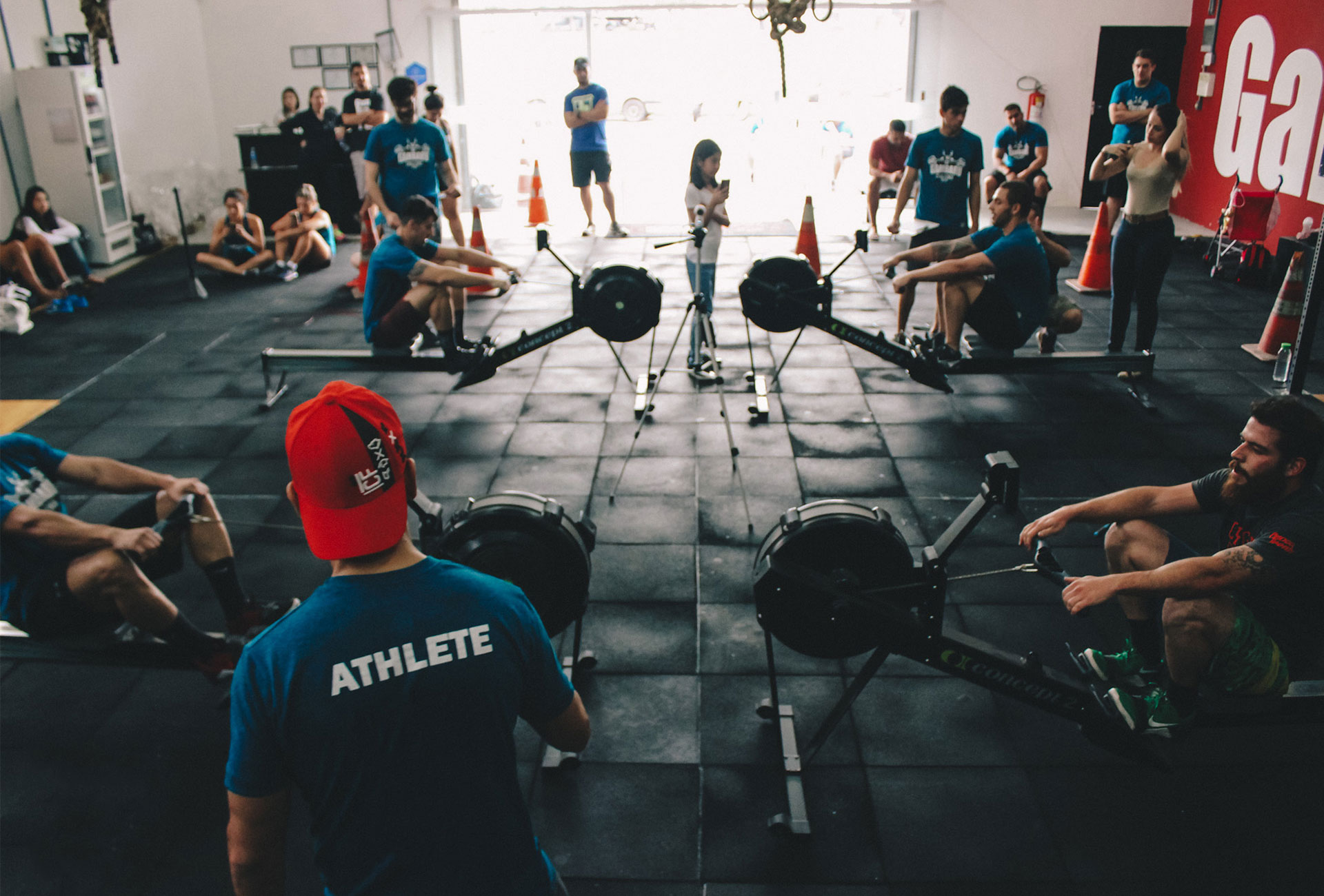

 Jonathan Meltzer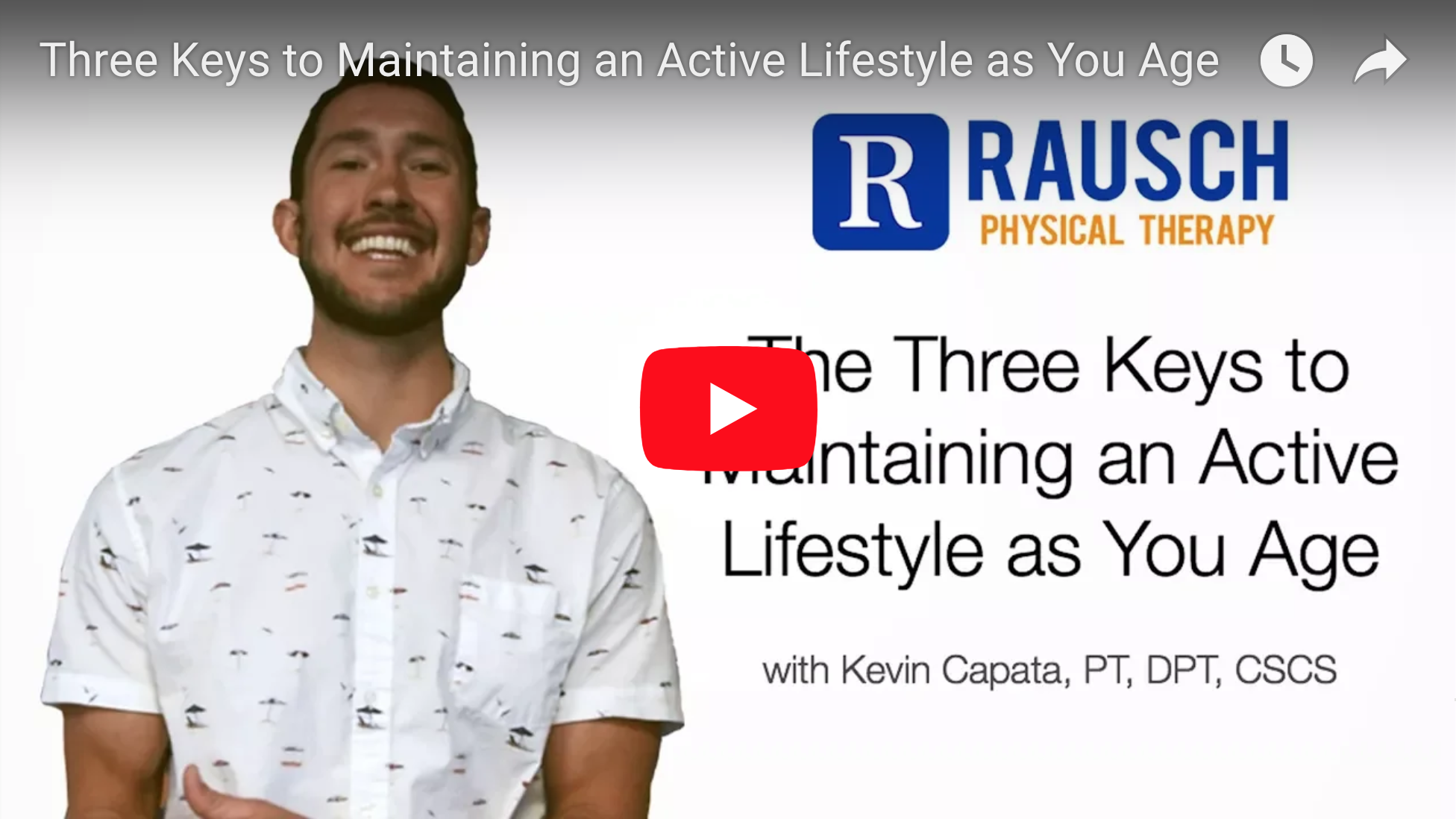

 Kevin Capata, PT, DPT, CSCS