
Running and Foot Archives - Page 3 of 3 - Rausch Physical Therapy & Wellness

Blog

Are You Falling for These Four Common Running Form Myths?


Don’t let common running myths hold you back from reaching your full potential, or worse, put you at risk for injury. PT Kevin Capata puts these misconceptions to rest in hopes of changing the way we all think about “perfect” run form.

Are You Falling for These Four Common Running Form Myths? 1
BY KEVIN CAPATA, DPT, RAUSCH PHYSICAL THERAPY
If you are a runner, treat runners, or even just know someone that runs, you have most likely been involved in the never-ending debate on what is the “correct” way to run. Well, I hate to burst everyone’s bubble, but the truth is this: There is no “one size fits all” answer!

These days, runners come in all shapes and sizes, and they run at various fitness and experience levels; this is why people often come up short on their search for THE best way to run—it really does depend on each individual person. However, that doesn’t mean you can’t figure out a better, more economical, and more efficient way to run depending on your individual body structure and function.

So, to finally abandon this one-size-fits-all approach to “perfect” running form and shift the way the world thinks about running, let’s examine a few common myths and misconceptions that may be holding you back from reaching your full potential, or even causing injuries.

NOTE: All these recommendations are assuming you are healthy with no current injuries. If you are unsure, first make an appointment with your physical therapist to identify and resolve any chronic injury or pain.


Myth #1: Running is a Hobby

First things first, it’s important to understand that running is a sport—not a hobby—which means running requires specific athleticism in terms of strength, balance, range of motion, stability, mobility, etc. As with any sport, developing fundamentals is the key to success. Once you have the fundamentals down pat, variability/adaptability become king!

Take a look at the top 10 jump shooters in the NBA. Each athlete exhibits similar and consistent fundamental motor patterns, form, and mechanics that are essential to being a good basketball player, however each individual also displays slight differences that they’ve found have made them successful. It’s these small variations built on top of the sports’ fundamentals that has set these athletes apart and elevated them to the elite level.

While it may seem totally unrelated, by treating running as a sport and applying this similar concept of developing fundamentally “good” running form, then building on it, you can get faster and prevent running-related injuries. Here are some of the fundamentals you should carry with you on every run:

  1. Maintain an upright posture with slight forward lean from your ankles, NOT from your hips or trunk. Avoid the dreaded “toilet bowl of doom” or “backseat” running postures, especially when fatigue sets in. (Fun tip: if you’re having trouble with this, go for a run where you’re sure to be seen—researchers have found that the majority of runners will straighten up when a runner of the opposite sex is coming towards them ☺)
  2. Land with your foot just in front of your Center of Mass (COM). If you land with your foot directly underneath you, you’re going to fall over, and if you overstride you’ll lose energy, endurance, go slower, and risk multiple lower extremity injuries.
  3. Focus on pushing off from your posterior chain. Yes, those infamous glutes, core and hips. Get your foot off the ground as quick as possible, working on elastic recoil and spring. Think plyometrics and quick, powerful movements. Just like you compress a slinky down and then let it go, this is how we want to think about our legs as we run.
  4. Use your arms. Reciprocal arm swing will help generate power and momentum, as well as maintain your balance and rhythm. Keep a rhythmical arm swing with your shoulders relaxed and elbows brushing up against your hips, not crossing in front of your midline.


Myth #2: Anyone Can/Should Run

Like I mentioned above, running is a sport—not a hobby—meaning not everyone can/should just “hit the ground running.” Now don’t get me wrong, I love running as a way to get in shape, but IF and ONLY IF it’s something that’s gradually (very gradually!) built up to. We live in a time of instant gratification, however the truth is that developing the skill of running, improving strength, and changing motor patterns are habits that take time and hard work. Read any book about building habits or becoming proficient at a skill and I bet it mentions something about “10,000 hours” or “6,000 repetitions” of focused practice to master a specific skill; running is no different.

So listen up! If you a) have never ran competitively before (e.g. high school or college cross-country, track, or other running team), b) have a BMI in the “overweight” category, or c) haven’t been doing cardiovascular fitness training at least three to four times per week for the past two to three months, then you should NOT start running on a consistent basis without first getting individual instruction, coaching, and/or gait analysis. You need to learn how to build your endurance, volume, and intensity overtime, and you should have an expert analyze your current gait and running patterns.

Why is this so important? It’s no coincidence that “running-related” injuries have become so prevalent over the past three decades. Runners used to be predominantly male athletes who ran for competition—skinny guys who were dedicated to the sport and coming in first place. Nowadays, there are more recreational runners who run a marathon just to finish; some are overweight and most are involved in cross-training activities; not to mention that females now make up the slight majority (54%) of runners.

So please, do your body a favor and be patient, take the time to make sure you “get fit to run” before signing up for that first half or full marathon. It will be more fun and rewarding and much less painful if you do.

Myth #3: You Should Run the Same Way Every Time

Efficiency and variability—develop these two attributes as a runner and the rest will take care of itself. The human body is an amazing specimen that adapts to the loads that you place on it, so use that to your advantage! Stand on one leg all day long, and I guarantee you that leg will get stronger and your balance will improve. Change the way in which your foot strikes the ground, and you will be prepared for any surface, incline, decline, or obstacle thrown your way. Again, this takes time! For instance, run some days slow, some days fast, other days both; throw in some hill repeats, some short speed sessions, increase your cadence when you’re feeling good, and slow it down when you’re fatigued.

Myth #4: Cadence is Key

According to numerous studies, the fastest runners take about 90 steps per leg each minute. However, this should not be taken as a stand alone statistic because cadence (or turnover, stride rate, etc.) is a function of an individual’s speed and stride length, as well as physical and cardiovascular capacity. Basically, each person will feel most comfortable and perform optimally at different step rates.

However, it is true that by increasing your cadence you can dampen ground reaction forces, decrease joint loading and impact forces, as well as improve your economy and speed. Therefore, the best thing to do is to either count (or download one of several apps that counts) your average cadence during your run. Play around with going fast, slow, up/down hill, fatigued and energetic, and get an average number. You should be between 160 to 190 steps per minute. If you’re within this range, you can then experiment with increasing and decreasing throughout a run and keep track of what feels most comfortable, what’s less physically taxing over longer distances, and what yields the quickest results. That is the range that your body prefers—assuming all fundamentals listed above are also abided to!

Conclusion

While running mechanics and form can become a complex and heated subject, we have to first and foremost acknowledge the fact that running is a sport and skill that requires time, dedication, and focused practice to achieve results. My main hope is that by taking this approach, we can start to limit the amount of injuries, pain, and suffering that a majority of recreational runners are experiencing on a daily basis.

If you’re still lost and want to take the first steps to becoming a better, faster, and more efficient runner, come in and schedule a Run Right with us at Rausch Physical Therapy & Sports Performance and not just PR your next race, but have fun and be injury free after.



K2Kevin Capata, PT, DPT, CSCS is a licensed physical therapist at Rausch Physical Therapy & Sports Performance. After receiving his Doctor of Physical Therapy degree at Columbia University, Kevin started his career at Rausch PT, where he used to work as a physical therapy aide. Now, Kevin enjoys helping his patients recognize and fix movement faults to help them overcome their injury or pain, as well as empowering them with the knowledge and tools to prevent re-injury or potential new injuries.

Click to learn more about Kevin and our other physical therapists »


How to Get Race Ready in Five Steps

When was the last time you rolled up on race day feeling 100% prepared? Think back to your last big race, were you healthy, well-rested and happy with your training? There are so many factors to getting race ready; it takes a lot of planning to get it right, but it is possible.

Unfortunately, I normally work with athletes who don’t get it right. They end up hurt, bummed and sulking into our physical therapy office. The funny thing is, all I usually hear during that first appointment is, “I know better,” or  “Yeah, I felt this pain starting a couple months ago, but…”

Enough with the buts! Here are five easy steps to follow to make sure you get it right for your next big race. These steps work for any kind of race—running, cycling, triathlon, ultra or IRONMAN.

Step 1: Start training sooner.

Don’t rush into a long distance race without giving your body enough time to train to adapt. Your body is amazing and it will adapt to what you ask it to do; you just have to give it the right amount of stimulus and time. It’s pure physiology from there. Tough workouts break down muscle fibers and cause micro-inflammation in your tissues; the recovery time in between workouts allows your body to heal and subsequently get stronger each week.

However, this could be a lot to ask of your body if you decided to just go hard every day for a month in anticipation for a big race. That’s where the magical taper time comes in (See Step 5.)

Step 2: Pilates & Yoga count during your training.

Don’t skip core and flexibility training—those two are the keys to injury prevention.

Step 3: Love your tissues.

Stretch every night, use the foam roller and/or massage stick, and make regular appointments to get worked on by a manual physical therapist or therapeutic massage therapist.

Step 4: Recover.

In between every work out, use recovery tights, Norma-tech, Compex, hydrate, and eat like an athlete.

Step 5: STOP! Taper Time.

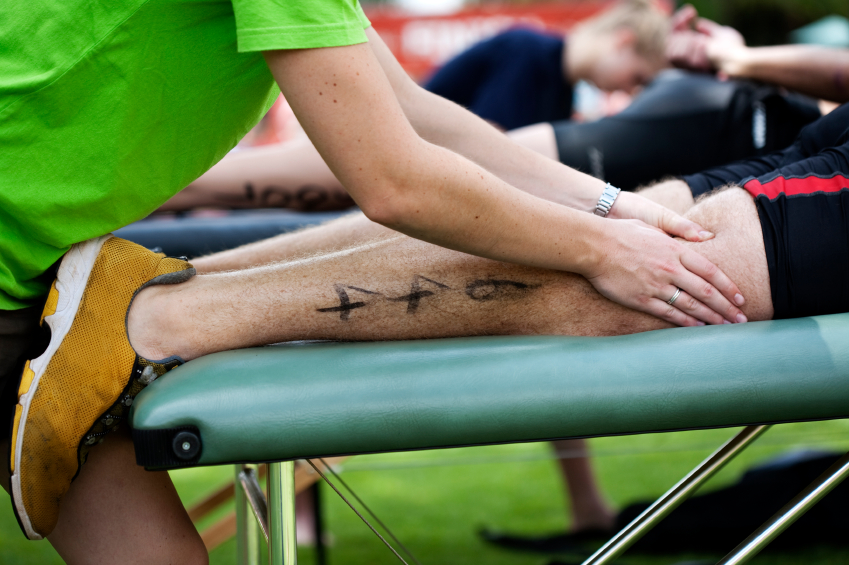
sports-massagePlan for a “tapering period” and build it into your training schedule. Tapering periods can be one week for short races and up to three weeks for longer races. Start to taper by decreasing the distances/time of your workouts, then use that saved time for MORE TISSUE WORK (See Step 3.) At minimum, get one massage during your taper period, but a couple would be better!

Benefits of training tapering

By scheduling in a tapering period toward the end of your training block, you give your body the final healing and prep time it needs before a race. However, this can only occur if you take advantage of the “extra” time you have because your training volume is lower. If you get massage work done, stretch, and use strategies to benefit from this tapering period, then your body will do its final recovery from all your months training.

Finding out how much taper time your body needs is a balancing act that you’ll get better at every year. Working with an intuitive coach can help, but remember that you are the only one your body talks to, so it’s up to you to listen to what your body is trying to tell you and act accordingly.

FINAL STEP: Enjoy the heck out of your race!

Once you get into the groove of well-planned training, core work, tissue work, recovery, and tapering, you’ll realize how much easier it is to be a successful racer.

All the best to your health,

Inbox-35061-messages-1987-unread


Kevin RauschAs the president and founder of Rausch Physical Therapy & Sports Performance, Kevin Rausch, PT, MPT takes great pride in the care of every single patient he treats. Kevin specializes in sacroiliac joint dysfunctions, running and cycling injuries, and return-to-sport planning for athletes. Since the first day he opened his clinic in 2006, Kevin has strived to provide the best in care, service and technology so as to strengthen his patients’ total body health and get them back to doing what they love.

Find Kevin on Google+


Gait This

There are many ways to do something, but often time there is a better or best way. Just because you can do something a certain way, doesn’t mean you should. Example: You can drive a car at 5000 RPM at all times. The car is fully capable of this and will withstand it…for a while. Your running gait is similar. You can get away with poor mechanics and gait for a while, but in the end it will catch up with you. It will present itself in the form of having to cease running, injuries, or being forced to slow down. None of these are desirable outcomes. The investment of a running gait analysis can really help to identify the key form flaws that will lead to major issues.

Did you know the Performance Lab offers such service? We call it “Run Right.” Get your running mechanics analyzed just in time for the off season of racing. Allow yourself the leisure of pressure free training while you strengthen and correct your run form.

Read more about Gait Analysis.

Questions? email jack@rauschpt.net Jack McPheron, Performance Lab Director


School Shoes

Make the most important decision for your child’s athletic career and foot health for the rest of their life.

Pick the right shoe!

We are cursed with weak, deformed, narrowed, and problematic feet. And it started when we were small. Those super cute shoes that you shoved your kids feet into for way too long are the start of the dysfunction that permeates a lifetime of tough footwear choices.

I am not a crazed barefoot dictator, there are in fact some shoes out there that are great for your feet and your kids feet.

But what do short and tight shoes do to your foot anyway?

In short, they bend your toes inward (causing bunions); tighten your calves (changing your posture & run form); weaken your feet (altering the way you run); and so much more…

These effects start the minute you put on a shoe that is too small, too tight, has a high heel and so on. All of these alter the normal mechanics of you foot leading to more and more changes as you age.

The detrimental effects are somewhat noticeable during childhood and may look like Severe’s Disease.

Then when sports get a little more intense during early teen years foot dysfunction can lead to Patellar Tendonitis.

Fast forward another 15 years when you’ve started to recapture your youth and get back into fitness by training for a Half Marathon, you wind up with Plantar Fascitis. Jump another 20 years, and you’re having a hard time walking around the harbor because of knee arthritis. Told you this was a big deal…

Of course there is hope!

At any time in this cycle you can choose the right shoes and take care of your feet. So start with your kids this year. Check out this list when buying shoes:

  1. Buy bigger! Give them as much room as possible
  2. Look for a wider toe box (the front of the shoe)
  3. FORGET stability shoes (they don’t work nor have they ever…)
  4. Get the flattest shoe possible (zero drop is a big buzz word)
  5. Say no to heels!

Remember, less is more.

All research has shown that extra padding in shoes is a waste and actually causes more trauma to the foot and knee joints as well. Think about shoes like Vans or Converse. They protect your feet from the ground, but allow your feet to work like they should. Furthermore, take your shoes off as much as possible. Play barefoot in the grass, sand or dirt. Its great for your feet!

Shoe Recommendations:

School Shoes:

  • Altra
  • Vans
  • Merrell
  • Converse

Running Shoes:

  • Newton
  • Altra

Take the time this year, to get your kids feet into the most mechanically sound shoes possible. It matters now and later. Our feet didn’t get this messed up overnight, so if you’ve got issues; get into the office ASAP so we can help direct you back on track. We’re here to help.

Kevin signature

There is a better way to Run!

Each and every runner possesses a unique running style based on their injuries, anatomy, and experiences. We all have our little hitches and traits, however, there is a better way to run. Every runner has inefficiencies in their gait that cost energy and speed. A Run Right will help you to identify these inefficiencies to enable you to run faster and stronger for longer.


Here’s how it works:

  • Your Run Right analysis begins with a comprehensive physical evaluation to determine your muscle recruitment patterns, range of motion, pains, and running background. Following the physical evaluation you will have a chance to experience the Alter-G Treadmill to have your gait analyzed. Video recording will be utilized from 4 different camera angles to get a complete view of your running gait.
  • Following the video recording, we will walk you through your gait frame by frame. Inefficiencies and biomechanical flaws will be identified and strategies to correct them will be provided.
  • After the analysis, we will put you back on the Alter-G treadmill to practice your efficient gait with running cues.
  • The analysis will finish with us walking you through your results. Strategies for improvement and necessary strengthening regimen will be discussed along with key exercises to ensure a successful home program.
  • All runners will be sent home with their results, a self massage ball, and the knowledge on how to Run Right.

Everyone can benefit from a Run Right!

Be sure to call the clinic and get yours scheduled today (949) 276-5401.


It’s time to Run Right into your race season

We have the answer. Run Right. Our 1-on-1 session between you and a certified running coach. Did you know the certified running coaches are also Physical Therapists? Two experts in one. Lucky YOU!

During the Run Right session your running mechanics are completely analyzed and videotaped to capture your bodies movement and form to identify any biomechanical issues, technical flaws or muscle imbalances that are causing pain or soreness.

A personalized plan is created including specific exercises and drills to improve your mechanics. Poor running form often results from tight, weak muscles. By identifying these areas and strengthening you can improve your performance and help to minimize the risk of injury.

Call the clinic today (949) 276-5401 to schedule your session.

Learn how to Run Right and run strong!

Check out the The Whole Body Fix article in Runner’s World. It’s a fantastic article about running right, understanding the purpose of an evaluation session and the importance to prioritize rehab!

http://www.runnersworld.com/injury-prevention-recovery/the-whole-body-fix