
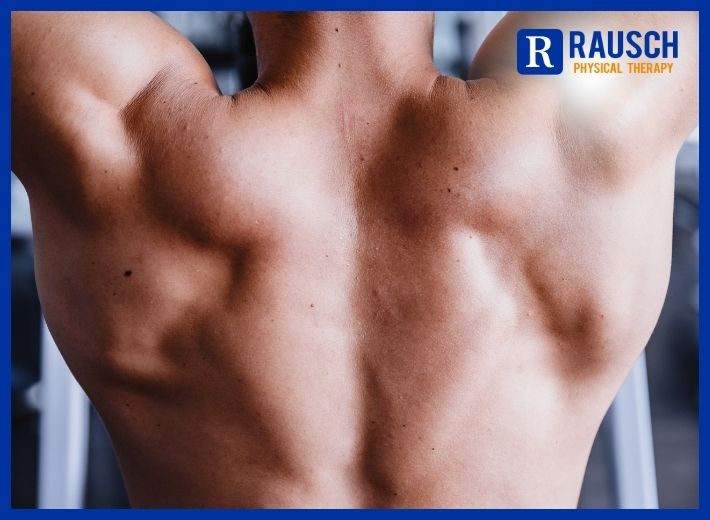
That tight, tender lump on top of your shoulder is one of the most common things we see at Rausch PT. Most of the time it’s a trapezius knot: a small patch of muscle that’s been working too hard for too long. The good news is that a trapezius knot usually responds well to the right mix of pressure, stretching and a few changes to how you sit and move. Here’s how our physical therapists explain it to patients, and what we have them do at home.
What Are Muscle Knots?
A muscle knot (the clinical name is a myofascial trigger point) is a small, tight band inside a muscle that won’t fully let go. Press on it and it feels like a firm pea or marble under the skin. It’s often sore right where you press, and it can also send an ache somewhere else, like up your neck or toward your shoulder blade.
Knots aren’t a sign that something is torn or damaged. They’re a sign that the muscle is overloaded and stuck in a guarded state.
Causes of Muscle Knots in Your Traps
Your trapezius is a big, kite-shaped muscle that runs from the base of your skull, across the tops of your shoulders and down the middle of your back. It shrugs your shoulders, lifts and rotates your shoulder blades when you reach overhead, and pulls them back and down when you sit up tall.
The upper portion, the part along the sides of your neck and the tops of your shoulders, is where we find most knots. A swollen trapezius lump in that area is usually tender to touch and can spread pain into the neck, the shoulder or between the shoulder blades.
In our clinics, the usual causes are:
- Long hours at a desk or on a phone. Head forward, shoulders creeping up toward your ears, for hours at a time.
- Stress. A lot of people hold tension in their upper traps without noticing until the end of the day.
- Weak or tired helpers. When the muscles around your shoulder blade can’t do their share, the upper trap picks up the slack and gets overworked.
- Repetitive overhead work or sport. Swimming, surfing, throwing, lifting, even carrying a heavy bag on the same shoulder every day.
Trapezius Knot Release Techniques
You don’t need to wait for the knot to get bad before you do something about it. A knot that isn’t very painful can still change how your shoulder moves, and that matters if you reach overhead a lot at work, in the gym or on the water. These are the steps we give patients for trapezius knot release at home.
1. Release Your Trigger Point
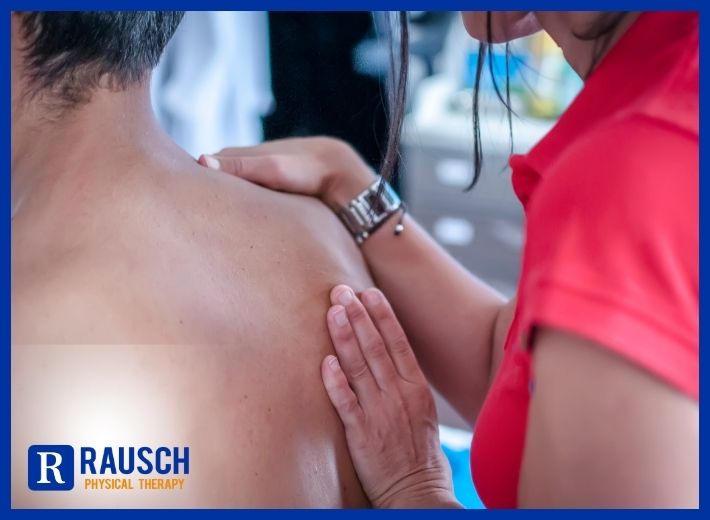
This is the same idea as the pressure work our therapists do by hand, just with a ball instead. Use a massage ball, tennis ball or lacrosse ball.
- Stand with your back to a wall.
- Put the ball between the wall and the knot on top of your shoulder, then lean in. Aim for pressure that feels strong but tolerable, around a 5 or 6 out of 10.
- Stay there. When the tenderness drops by about half, lean in a little more.
- Keep going until it eases off. That can take anywhere from 30 seconds to a couple of minutes.
You can also do this lying on your back with the ball under the knot, which some people find easier to control.
2. Stretch It Out
Once the knot has softened, a gentle stretch helps it stay that way. Hold for 20 to 30 seconds and do three rounds on each side.
- Sit tall and let your ear drop toward the shoulder on the side that doesn’t hurt.
- Rest your hand on top of your head to add a little weight. Don’t pull.
- Turn your chin slightly up or down to find different parts of the muscle.
3. Apply Cold or Heat
If the pain is sharp, or it flared up right after a workout or a long paddle, use ice for 10 to 15 minutes.
If it’s the dull, nagging kind of knot in your trapezius that’s been hanging around for days, use heat instead for 15 to 20 minutes. Heat increases blood flow and makes the muscle easier to relax, so it’s a good warm-up before the ball and the stretch.
4. Squeeze Your Scapula
Hammering an irritated upper trap with heavy shrugs usually makes things worse. What helps is strengthening the muscles underneath it, the ones that hold your shoulder blades in place, so your upper trap doesn’t have to do everything. Scapular squeezes are a simple place to start, and you can do them at your desk.
- Sit up straight on a firm chair.
- Let your arms hang relaxed, then squeeze your shoulder blades back and slightly down, like you’re pinching a pencil between them.
- Hold for two to three seconds, then relax.
- Do 10 reps, and build up to three sets.
Keep your shoulders away from your ears the whole time. Doing it in front of a mirror helps you catch yourself shrugging.
 5. Get a Massage
If the ball isn’t getting you there, hands-on work from a professional can. A trained massage therapist can find the exact spot, work around it and use techniques you can’t do on yourself. A massage gun can help between sessions, but go lightly on the neck. At Rausch PT, our Rx Massage therapists work alongside our physical therapists, and StretchFix assisted stretching can help keep your upper traps loose between visits.
6. Perfect Your Posture
If your knots keep coming back, look at your setup before you look at anything else. A few changes make a big difference:
- Set your chair height so your feet are flat on the floor and your thighs are level. Use a footrest if you need one.
- Bring your keyboard and mouse close enough that your elbows stay by your sides and your shoulders can relax.
- Put the top of your screen at eye level, about an arm’s length away. Laptops on a desk almost always pull your head forward.
- Get up every 30 to 45 minutes. Roll your shoulders, take a short walk, reset.
When to See a Doctor
Most lumps on top of the shoulder are trigger points. Still, a lump on your trapezius isn’t always a knot. Get it checked by a doctor if it:
- shows up suddenly or keeps getting bigger,
- feels hard and doesn’t move when you press it,
- turns red, feels hot, or drains fluid or blood,
- comes with fever, unexplained weight loss, or numbness or weakness in your arm.
And if a knot just won’t go away after a couple of weeks of doing the right things, that’s a good time to see a physical therapist. In California, most patients don’t need a referral to book an evaluation.

Trapezius Knot FAQs
How do you release a trapezius knot at home?
Press a massage, tennis or lacrosse ball into the knot while leaning against a wall. Hold until the tenderness drops by about half, then press a little deeper. Follow it with a gentle side-bend neck stretch held for 20 to 30 seconds, three times per side. Heat for 15 to 20 minutes can help an achy knot relax.
How long does a trapezius knot take to go away?
Mild knots often ease within a few days to a couple of weeks with self-release, stretching and better posture. A knot that keeps coming back usually has a cause behind it, like your desk setup, stress or weak upper back muscles, and that cause needs to be fixed too.
Can a knot in your trapezius cause headaches?
Yes. Trigger points in the upper trapezius can send pain up the side of the neck and into the head, which is why trap knots often go hand in hand with tension headaches.
Should I see a physical therapist or a massage therapist for trap knots?
Massage is a good way to calm a tight, knotted muscle. If the knot keeps returning, limits how you turn your neck or lift your arm, or comes with pain or tingling down the arm, a physical therapist can find out why and build a plan to fix it. At Rausch PT you can get both under one roof.
When is a lump in the trapezius a concern?
See a doctor if the lump keeps growing, feels hard and fixed in place, turns red or hot, or drains fluid. Most lumps on top of the shoulder are trigger points, but anything that changes quickly should be checked.
Experiencing stubborn muscle knots in your traps that just won’t go away? Our expert physical therapists can help! Discover effective, personalized strategies to release tension, reduce pain, and improve your mobility. At Rausch PT, everyone from our friendly front office staff to our dedicated aides is here to cheer you on and help you achieve your goals. We strive to give you the best experience possible every time you come see us, which is why your personal Rausch physical therapists will be by your side throughout your entire treatment. Call our physical therapy center today at 949-276-5401. For more tips, you can also connect to our IG.