
Rausch Physical Therapy & Sports Performance — Laguna Niguel • Dana Point • Mission Viejo
Pickleball has been named America’s fastest-growing sport for several years running — and nowhere is the boom more obvious than here in South Orange County. Courts in Laguna Niguel, Dana Point, and Mission Viejo are packed from sunrise to sunset. But as participation has exploded, so have pickleball-related injuries, especially among players over 40.
Here’s the good news: the most common pickleball injuries are largely preventable. At Rausch Physical Therapy & Sports Performance, our Doctors of Physical Therapy help racquet-sport athletes of every age play harder, recover faster, and stay off the injured list — and our StretchFix assisted stretching program has quickly become the not-so-secret weapon of local pickleball players. Here’s your complete guide.
How Can I Improve My Pickleball Game Without Getting Injured?
The fastest way to get better at pickleball isn’t just more court time — it’s building a body that moves better. Power in pickleball comes from your legs, hips, and core, not just your paddle arm. When those areas are strong and mobile, you get to more balls, hit with more control, and put far less strain on your shoulders, elbows, and knees.
Key Strength Exercises for Pickleball Players
Add these 2—3 times per week and your game (and joints) will thank you:
- Squats and split squats — build the leg drive behind every lunge, drop shot, and quick recovery step while protecting your knees.
- Lateral lunges and side shuffles — side-to-side movement is the heart of pickleball; training it directly reduces ankle and knee sprains.
- Single-leg balance work (single-leg reaches, single-leg deadlifts) — improves ankle stability for fast direction changes.
- Rows and band pull-aparts — balance out all that forward, paddle-side dominance and keep your shoulders healthy.
- Farmer’s carries and forearm work — grip strength is your first line of defense against elbow and wrist overuse injuries.
The Best Off-Court Activity for Pickleball Players: Assisted Stretching
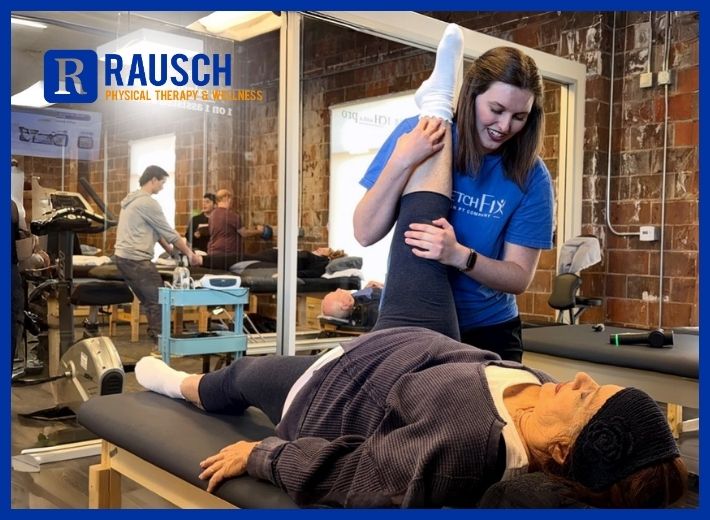
If strength is half the equation, mobility is the other half — and it’s the half most players skip. That’s exactly what StretchFix was built for. Crafted by Doctors of Physical Therapy, StretchFix is a one-on-one assisted stretching program where a trained practitioner takes your hips, hamstrings, calves, shoulders, and spine through a deeper, safer range of motion than you can ever reach stretching on your own.
For pickleball players, that translates to a longer reach at the kitchen line, a quicker first step, smoother rotation on drives — and far less wear and tear between games. Book a StretchFix session here and feel the difference on the court within a week.

The Most Common Pickleball Injuries — and How to Prevent Them
Emergency rooms and PT clinics nationwide have seen pickleball injuries surge alongside the sport’s popularity. These are the ones we treat most at Rausch PT:
- Ankle sprains — from quick lateral movements and sudden stops.
- Calf and Achilles strains — especially common in players over 40 who go from zero to full speed without warming up.
- “Pickleball elbow” (lateral epicondylitis) — yes, the same condition as tennis elbow. More on that below.
- Rotator cuff strains — from repetitive overhead smashes and serves.
- Wrist injuries and fractures — usually from bracing a fall.
- Knee sprains and meniscus irritation — from pivoting and lunging on hard courts.
Simple Exercises That Prevent Them
- Calf raises (straight-knee and bent-knee) plus slow, controlled heel drops — your best insurance against Achilles trouble.
- Wrist curls and extensions with a light dumbbell — condition the forearm tendons that take a beating from dinks and drives.
- Banded shoulder external rotations — keep the rotator cuff strong enough for overheads.
- Planks and side planks — a stable core protects your lower back on every twist and reach.
Why StretchFix Is a Pickleball Player’s Best Friend
Notice a pattern in those injuries? Almost all of them start with tight, under-prepared tissue. Tight calves overload the Achilles. Stiff hips force your knees and lower back to absorb every lunge. Restricted shoulders turn an easy overhead into a rotator cuff strain.
Regular StretchFix sessions systematically restore that lost range of motion, so your muscles and tendons can absorb the demands of play instead of breaking down under them. Think of it as a maintenance plan for your pickleball body — most of our regulars come in weekly or biweekly and swear by it. Reserve your spot here.
What Causes Tennis Elbow — and How Can Physical Therapy Help?
Despite the name, you don’t need to play tennis to get it — pickleball players are one of the fastest-growing groups we treat for it. Tennis elbow (lateral epicondylitis) is an overuse injury of the tendons that anchor your wrist-extensor muscles to the outside of your elbow. Repetitive gripping and swinging — especially with a paddle that’s too heavy, a grip that’s the wrong size, or backhand mechanics that rely on the wrist instead of the shoulder and trunk — gradually overloads those tendons until every handshake, coffee cup, and backhand hurts.
Physical therapy is the gold-standard, non-invasive treatment. At Rausch PT, your therapist works with you one-on-one through your entire plan of care to:
- Find the true root cause — often weakness in the shoulder or poor swing mechanics further up the chain, not just the elbow itself.
- Calm the pain down with hands-on manual therapy and smart load management (usually without stopping play completely).
- Rebuild tendon capacity with progressive, eccentric strengthening — the approach research consistently supports.
- Correct grip, equipment, and technique factors so it doesn’t come back.
Bonus: California is a direct-access state, which means you can start physical therapy at Rausch without waiting for a physician referral in most cases. The earlier tendon issues are treated, the faster they resolve — don’t play through it for six months first.
The Best Warm-Up Routine for Pickleball Players Over 40
Most pickleball injuries in players over 40 happen in the first 15 minutes of play — cold muscles and tendons simply can’t handle explosive movement. This 6–8 minute dynamic warm-up is the cheapest injury insurance there is:
- Brisk walk or easy jog around the court — 2 minutes to raise your body temperature.
- Leg swings — 10 forward/back and 10 side-to-side per leg.
- Walking lunges with a gentle torso twist — 10 total.
- Lateral shuffles — 2 trips across the court, gradually picking up speed.
- Arm circles and band pull-aparts — 15 each to wake up the shoulders.
- Wrist circles and a gentle forearm stretch — 30 seconds.
- Progressive dink rally — start soft, build to game speed over 2 minutes.
Save the long static stretches for after you play — or better yet, let us do the stretching for you. A weekly StretchFix session is the perfect recovery ritual for players over 40: it targets exactly the areas (calves, hips, hamstrings, shoulders) that stiffen with age and playing volume, keeping you loose enough to play multiple days a week — pain-free.
FAQs: Pickleball, Injuries & StretchFix
What exactly is StretchFix?
StretchFix is Rausch PT’s one-on-one assisted stretching program, designed by Doctors of Physical Therapy. A trained practitioner guides your body through targeted, PT-informed stretches to improve mobility, speed recovery, and reduce injury risk. Learn more and book here.
How often should I do StretchFix if I play pickleball several times a week?
Most regular players do best with one session per week; players logging four or more days on the court often benefit from twice weekly. Your practitioner will tailor a cadence to your body and schedule.
Do I need a doctor’s referral to start physical therapy?
In most cases, no — California allows direct access to physical therapy, so you can book an evaluation as soon as something feels off.
Where is Rausch PT located?
We have three South Orange County clinics: Laguna Niguel (30100 Town Center Drive), Dana Point (24582 Del Prado Ave), and Mission Viejo (24000 Alicia Pkwy). All three offer physical therapy and wellness services.
Ready to Play More and Hurt Less?
Don’t wait for an injury to force you off the court. Whether you want to move better, recover faster, or finally fix that nagging elbow, the Rausch PT team can get you there.
- Book your StretchFix session — the #1 off-court move for pickleball players.
- Schedule a physical therapy evaluation — no referral needed in most cases.
- Call us at (949) 276-5401 with any questions.
- Follow us on Instagram @rauschpt for weekly mobility tips, specials, and community events.
Rausch Physical Therapy & Sports Performance — helping South Orange County athletes get back to doing what they love.